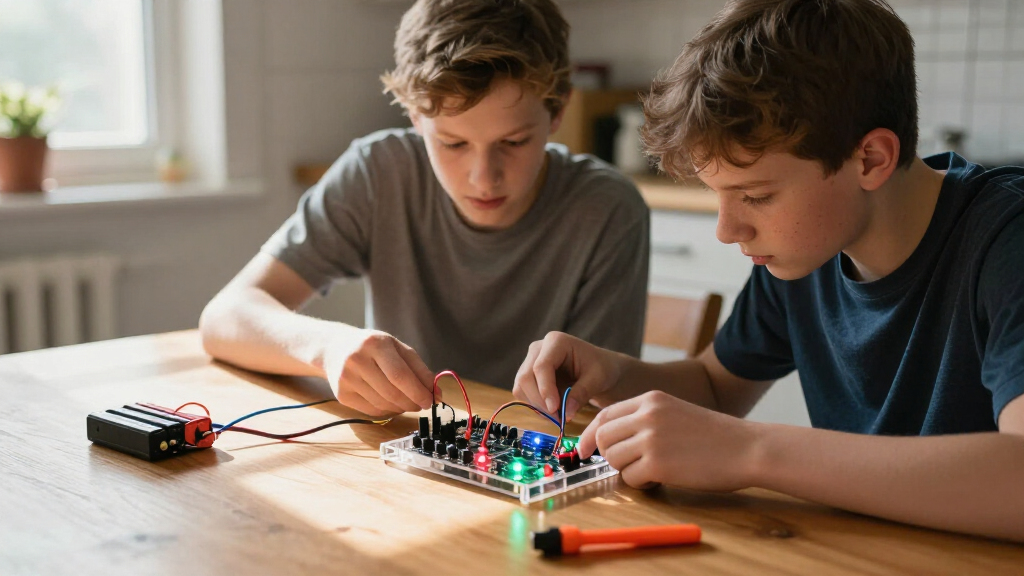

For teens who want to build, experiment, or solve problems, the ELEGOO UNO R3 Smart Robot Car Kit V4 with Camera is my best overall pick because it offers hands-on robotics with room to explore programming. The UNGLINGA 150-Experiment Science Kit suits teens who want variety, while the DIY Bluetooth Speaker Kit offers a focused electronics project with a working result. The main tradeoff is between a broad set of short activities and a more demanding build that develops a specific skill. Age labels can also be misleading: teens’ patience, experience, and interest matter more than the number on the box. Read on for the full breakdown and help matching a kit to the kind of science your teen actually wants to do.

Prime made for students and young adults
- Fast, free delivery for dorm and study essentials
- Prime Video and Amazon Music included
- Member-only deals
Key Takeaways
- The lineup’s strongest teen-oriented option is the ELEGOO robot car: its robotics and camera features offer more room to explore than a single-build radio or speaker project.
- The UNGLINGA 150-Experiment kit and National Geographic Amazing Chemistry Set favor breadth, but many short activities may feel less substantial than one sustained build.
- Electronics kits differ by outcome: the Bluetooth speaker and radio sets teach practical assembly, while the walkie-talkie kit centers on communication and paired use.
- The solar robot kits and MEWOCHEE 24-in-1 robot kit emphasize repeated rebuilding, while the robot arm kit focuses on mechanical movement and control.
- Several National Geographic kits carry younger age framing, so teens should check experiment depth and instructions rather than assume a large activity count means an age-appropriate challenge.
| CYOEST DIY Bluetooth Speaker Kit |  | Best for Electronics and Audio | Brand: CYOEST | Model: speaker2.0 | Materials: Wood and electronic components | VIEW LATEST PRICE | See Our Full Breakdown |
| DIY Walkie Talkie Building Kit – STEM Science Toy for Ages 6‑14 |  | Best for Communication Circuits | Brand: ANNISOKA | Model number: DK03 | Age range: 6–14 years | VIEW LATEST PRICE | See Our Full Breakdown |
| National Geographic Science Magic Kit for Kids |  | Best for Demonstration-Style Science | Brand: Blue Marble | Age range: 8 years and up | Experiments: 20 included, plus 85+ in the booklet | VIEW LATEST PRICE | See Our Full Breakdown |
| National Geographic Amazing Chemistry Set for Kids, 100+ Experiments |  | Best for Introductory Chemistry | Brand: Blue Marble | Age range: 8 years and up | Experiments: 15 kit-based experiments plus 85 bonus experiments | VIEW LATEST PRICE | See Our Full Breakdown |
| UNGLINGA 150-Experiment Science Kit for Kids |  | Best for Broad Science Variety | Brand: UNGLINGA | Experiment count: Up to 150 | Recommended age: 8 years and up | VIEW LATEST PRICE | See Our Full Breakdown |
| Robot Arm Kit – STEM Robotics Building Set for Kids and Adults |  | Best for Mechanical Robotics | Brand: ANNISOKA | Part number: A-48 | Recommended age: 8 years and up | VIEW LATEST PRICE | See Our Full Breakdown |
| ELEGOO UNO R3 Smart Robot Car Kit V4 with Camera |  | Best for Coding and Sensor-Based Robotics | Brand: ELEGOO | Model: US-EL-KIT-012 | Controller: UNO R3 | VIEW LATEST PRICE | See Our Full Breakdown |
| DIY Bluetooth Speaker and FM Radio STEM Kit for Kids |  | Best Two-Project Electronics Pick | Brand: choopheme | Projects: Bluetooth speaker and FM radio | Number of projects: 2 | VIEW LATEST PRICE | See Our Full Breakdown |
| DIY Wooden Radio Kit – STEM Science Project for Ages 6-14 |  | Best for a Simple First Radio Build | Brand: ANNISOKA | Model: DK02 | Age range: 6–14+ years | VIEW LATEST PRICE | See Our Full Breakdown |
| DIY FM Radio STEM Kit for Kids |  | Best Compact FM Radio Kit | Brand: CYOEST | Age range: 8 years and up | Frequency range: 88–108 MHz | VIEW LATEST PRICE | See Our Full Breakdown |
| MEWOCHEE 24-in-1 STEM Circuit Science Robot Kit for Kids |  | Best for Robot Variety | Brand: MEWOCHEE | Model: MEWOCHEE-ScienceRobotKit | Robot designs: 24 | VIEW LATEST PRICE | See Our Full Breakdown |
| Sillbird 12-in-1 Solar Robot Building Kit, 190 Pieces |  | Best for Renewable Energy Learning | Brand: Sillbird | Models: 12 | Number of pieces: 190 | VIEW LATEST PRICE | See Our Full Breakdown |
| National Geographic Break Open 10 Premium Geodes – Ages 8‑12 |  | Best for Hands-On Geology | Brand: Blue Marble | Age range: 8 years and up | Set name: 10 Geodes Kit | VIEW LATEST PRICE | See Our Full Breakdown |
| National Geographic Magic Chemistry Set for Kids |  | Best for Science Demonstrations | Brand: Blue Marble | Age range: 8 years and up | Experiments: 10 | VIEW LATEST PRICE | See Our Full Breakdown |
| STEM 13-in-1 Solar-Powered Robot Building Kit |  | Best for Land-and-Water Builds | Brand: Bottleboom | Model number: 2115 | Robot builds: 13 | VIEW LATEST PRICE | See Our Full Breakdown |
| educational science kits for teen | Brand | Age range | Dimensions |
|---|---|---|---|
| CYOEST DIY Bluetooth Speaker K | CYOEST | — | — |
| DIY Walkie Talkie Building Kit | ANNISOKA | 6–14 years | 2.75 × 1.73 × 7.08 in |
| National Geographic Science Ma | Blue Marble | 8 years and up | 8.86 × 3.15 × 12 in |
| National Geographic Amazing Ch | Blue Marble | 8 years and up | 8.78 × 3.19 × 11.93 in |
| UNGLINGA 150-Experiment Scienc | UNGLINGA | — | 11.42 × 8.67 × 3.94 in |
| Robot Arm Kit | ANNISOKA | — | 6.8 × 4.48 × 4.3 inches |
| ELEGOO UNO R3 Smart Robot Car | ELEGOO | — | — |
| DIY Bluetooth Speaker and FM R | choopheme | 8 years and up | — |
| DIY Wooden Radio Kit | ANNISOKA | 6–14+ years | 3.9 × 4.3 × 1.8 inches |
| DIY FM Radio STEM Kit for Kids | CYOEST | 8 years and up | 2.16 × 3.54 × 2.75 inches |
| MEWOCHEE 24-in-1 STEM Circuit | MEWOCHEE | — | — |
| Sillbird 12-in-1 Solar Robot B | Sillbird | — | 19.99 x 26.17 x 6.83 cm |
| National Geographic Break Open | Blue Marble | 8 years and up | — |
| National Geographic Magic Chem | Blue Marble | 8 years and up | — |
| STEM 13-in-1 Solar-Powered Rob | Bottleboom | — | — |
More Details on Our Top Picks
CYOEST DIY Bluetooth Speaker Kit
The CYOEST DIY Bluetooth Speaker Kit is my pick for teens who want to connect basic circuit concepts to a familiar piece of technology. Assembling a wooden speaker without soldering keeps the build approachable, while the Bluetooth board and 3 W-per-channel output give the project a practical audio purpose. Compared with the DIY Walkie Talkie Building Kit, this focuses on sound playback rather than communication, making it a better fit for teens curious about speakers and audio electronics. The tradeoff is that the kit’s learning scope is narrower than the UNGLINGA 150-Experiment Science Kit, which spans several science areas. It also needs four AA batteries that are not included, so have those ready before assembly. I’d choose it for a focused electronics project, not for a broad experiment collection.
Pros:- Connects circuit assembly with a recognizable audio device
- No soldering is required
- Compact wooden shell makes the finished project easy to place on a desk
- Includes a 2-year limited warranty
Cons:- Four AA batteries are required and not included
- The project focuses on one device rather than a range of science topics
Best for: Teens and families looking for a buildable audio project that introduces circuits without requiring soldering
Not ideal for: Buyers seeking many different experiments or a project that works without separately supplying batteries
- Brand:CYOEST
- Model:speaker2.0
- Materials:Wood and electronic components
- Speaker power:3 W per channel
- Shell size:4.9 × 2.9 × 3.2 in
- Power source:4 AA batteries, not included
- Assembly:No soldering required
- Recommended age:10 years and up
- Warranty:2-year limited warranty
Our verdict“Choose this kit for a teen who would rather build a working Bluetooth speaker than cycle through a variety of experiments.”
DIY Walkie Talkie Building Kit – STEM Science Toy for Ages 6‑14
This DIY Walkie Talkie Building Kit gives teens a clear reason to care about the electronics they assemble: the finished units are designed to communicate. The wooden parts go together without soldering or glue, and the pre-paired units are described as ready to work after assembly. That makes the project more immediately interactive than the CYOEST DIY Bluetooth Speaker Kit, which centers on listening to audio from a built device. The blank wood also leaves room for decorating, though paint markers are not included. Compared with the National Geographic Science Magic Kit, this is a more focused build and offers less variety in experiment types. The listed age range extends to 14, so older teens should check whether the straightforward assembly offers enough challenge. Adult supervision is recommended, and the pack quantity is one.
Pros:- Links basic electronics to a practical communication project
- No soldering or glue is required
- Pre-paired units are intended to work after assembly
- Blank wooden parts can be customized with paint or markers
Cons:- Adult supervision is recommended during assembly
- Paint markers for decoration are not included
- The straightforward build may offer limited challenge to older teens
Best for: Younger teens and families who want a guided electronics build centered on two-way communication and optional decoration
Not ideal for: Older teens seeking advanced circuit design, a broad set of experiments, or a kit with included decorating supplies
- Brand:ANNISOKA
- Model number:DK03
- Age range:6–14 years
- Dimensions:2.75 × 1.73 × 7.08 in
- Weight:0.28 kg
- Pack quantity:1
- Assembly:No soldering or glue required
- Included guidance:Instructions and optional online tutorial
Our verdict“Pick this for a younger teen who will enjoy assembling and personalizing a communication device more than doing a broad set of experiments.”
National Geographic Science Magic Kit for Kids
The National Geographic Science Magic Kit suits teens who like presenting a surprising effect and then learning the science behind it. It includes materials for 20 experiments, plus a booklet with more than 85 additional magic experiments, giving it more idea variety than the CYOEST DIY Bluetooth Speaker Kit but less emphasis on building an electronic device. Because it runs manually and requires no batteries, there is no power setup to manage. Its main limitation for teen buyers is the presentation: it is designed for one player and aimed at ages 8 and up, so older teens may find the included activities younger-skewing. The extra booklet ideas also do not mean all their materials are supplied. Compared with the chemistry-focused National Geographic Amazing Chemistry Set, this pick puts more weight on science demonstrations and magic-style presentation.
Pros:- Includes materials for 20 experiments
- Booklet adds more than 85 further experiment ideas
- Manual operation avoids batteries
- Combines hands-on STEM activities with presentation and demonstration
Cons:- Designed for one player rather than group collaboration
- The recommended age starts at 8, and some activities may feel young to older teens
- The booklet’s additional experiments do not indicate that all required materials are included
Best for: Teens who enjoy performing science demonstrations independently and want a collection of experiment ideas
Not ideal for: Older teens seeking advanced, collaborative lab work or a kit with supplied materials for every activity in its booklet
- Brand:Blue Marble
- Age range:8 years and up
- Experiments:20 included, plus 85+ in the booklet
- Number of players:1
- Educational objective:STEM
- Power source:No batteries required
- Operation mode:Manual
- Dimensions:8.86 × 3.15 × 12 in
- Item weight:1.5 lb
Our verdict“Choose this for a teen drawn to science demonstrations and magic-style presentation, rather than electronics construction or chemistry lab tools.”
National Geographic Amazing Chemistry Set for Kids, 100+ Experiments
For a teen specifically curious about chemical reactions and crystal growing, this set offers a more directed science experience than the National Geographic Science Magic Kit. Its test tubes, beakers, and pipettes make activities feel like small-scale lab work, while the box supplies materials for 15 experiments. The headline count needs context: the other 85 activities use common household items, which are not included. Compared with the UNGLINGA 150-Experiment Science Kit, this is less broad but clearer in its chemistry focus and tool selection. That narrower scope can be a benefit for a budding chemistry student, but it gives less variety across physics and earth science. The recommended age begins at 8, so teens should check the activity level against their experience and appetite for guided experiments.
Pros:- Centers activities on chemistry rather than general science
- Includes test tubes, beakers, and pipettes for hands-on work
- Supplies materials for 15 experiments
- Offers 85 additional experiment ideas using household items
Cons:- Materials for the 85 bonus experiments are not included
- The chemistry focus provides less subject variety than the UNGLINGA kit
- The recommended age starts at 8, so some teens may want more advanced activities
Best for: Teens interested in beginner chemistry activities, especially reactions and crystal growing, using basic lab-style tools
Not ideal for: Buyers who expect materials for all 100 activities or want a science kit spanning several subject areas
- Brand:Blue Marble
- Age range:8 years and up
- Experiments:15 kit-based experiments plus 85 bonus experiments
- Educational focus:STEM and chemistry
- Included tools:Test tubes, beakers, and pipettes
- Dimensions:8.78 × 3.19 × 11.93 in
- Item weight:1.8 lb
- Model number:NGMEGACHEMAR
Our verdict“Choose this chemistry-focused set if a teen wants structured reaction and crystal activities and is comfortable sourcing household supplies for the extra ideas.”
UNGLINGA 150-Experiment Science Kit for Kids
The UNGLINGA 150-Experiment Science Kit is the broadest choice in this group, with activities spanning chemistry, physics, earth science, and more. That range gives a teen room to sample different subjects, unlike the National Geographic Amazing Chemistry Set, which concentrates on reactions and crystal growing. An illustrated, step-by-step manual helps make the activities easier to follow, and the kit includes tools and materials for projects. Still, the stated total of up to 150 does not mean every experiment is self-contained: some use common household items, and adult participation may help with certain activities. Compared with the CYOEST DIY Bluetooth Speaker Kit, this favors variety over building one finished device. Its listed educational objective is creative skills, so buyers looking for a focused, advanced course in one science topic may find the coverage too wide and introductory.
Pros:- Covers chemistry, physics, earth science, and other areas
- Offers up to 150 hands-on experiment ideas
- Includes science tools and materials
- Illustrated, step-by-step manual supports guided activities
Cons:- Some experiments require household items beyond the kit
- Adult participation may be helpful for certain activities
- Broad subject coverage may not satisfy teens seeking depth in one science area
Best for: Families with teens who want to explore several science subjects through guided activities and can supply some household materials
Not ideal for: Teens seeking advanced study in one field or independent experiments that never need adult help or extra supplies
- Brand:UNGLINGA
- Experiment count:Up to 150
- Recommended age:8 years and up
- Set name:150 Experiments
- Number of items:1
- Included components:Science experiment tools and materials
- Dimensions:11.42 × 8.67 × 3.94 in
- Educational objective:Creative skills
Our verdict“Pick this for a teen who wants to sample many kinds of science, rather than focus on a single build or chemistry topic.”
Robot Arm Kit – STEM Robotics Building Set for Kids and Adults
I’d choose the ANNISOKA Robot Arm Kit for teens who want to see how mechanical parts and electronics work together, rather than start with a screen-based coding project. Its wooden components, motors, PCB microcontroller, and wiring make assembly a practical introduction to robotic systems, and no soldering is required. Compared with the ELEGOO UNO R3 Smart Robot Car Kit, this build centers on constructing and operating an arm, while ELEGOO offers sensors, camera features, and Arduino programming. That makes ANNISOKA a more focused fit for hands-on mechanism learning, but a less flexible choice for teens seeking software challenges. Assembly may be difficult for younger builders without adult help, and the six AA batteries are not included. I’d rank it below the more programmable car for teens wanting broader robotics exploration, but ahead of simple radio builds for mechanical engagement.
Pros:- Combines wooden mechanical parts with motors, wiring, and a PCB microcontroller
- No soldering required
- Assembly encourages problem-solving and engineering practice
- Suitable for a broad age range, from children to adults
Cons:- Requires six AA batteries that are not included
- Assembly may be challenging for younger builders without adult assistance
Best for: Teens and families who want a hands-on introduction to motors, wiring, and mechanical robotics without soldering
Not ideal for: Teens mainly seeking Arduino coding, camera-based projects, or a quick build; assembly can also need adult guidance for younger users
- Brand:ANNISOKA
- Part number:A-48
- Recommended age:8 years and up
- Material:Wood
- Electronics:Motors, PCB microcontroller, and wiring
- Soldering:Not required
- Dimensions:6.8 × 4.48 × 4.3 inches
- Batteries:6 AA batteries required; not included
Our verdict“Choose this kit for a teen interested in building a physical robot mechanism, rather than prioritizing sensors and coding.”
ELEGOO UNO R3 Smart Robot Car Kit V4 with Camera
For teens ready to connect a physical build with programming, I rank the ELEGOO UNO R3 Smart Robot Car Kit above the simpler radio and speaker projects in this group. Its UNO R3 controller, line-tracking and ultrasonic sensors, and camera create several ways to experiment: assemble the car, control it, and explore Arduino IDE coding. App and IR remote controls also give beginners a way to operate the vehicle before they write code. Compared with the ANNISOKA Robot Arm Kit, ELEGOO puts more emphasis on programming and sensor feedback, while ANNISOKA is better suited to learning about a mechanical arm and its components. The added capability comes with a steeper learning curve: builders must assemble and program it, and first-timers may need adult guidance. Its rechargeable 2000 mAh battery is included, but the 1.23 kg build is less compact than a small tabletop electronics project.
Pros:- UNO R3 controller supports Arduino IDE programming
- Camera, line-tracking, and ultrasonic sensors offer varied experiments
- App and IR remote control provide accessible ways to operate the car
- Rechargeable 2000 mAh lithium-ion battery is included
Cons:- Assembly and programming can be challenging for first-time builders
- Adult guidance may be needed to get started
- At 1.23 kg, it is less portable than compact tabletop kits
Best for: Teens who want to assemble a robot, explore Arduino coding, and experiment with camera and sensor functions
Not ideal for: Beginners wanting a short, low-complexity electronics build or teens uninterested in programming and assembly
- Brand:ELEGOO
- Model:US-EL-KIT-012
- Controller:UNO R3
- Camera and Wi-Fi module:ESP32-WROVER-based
- Sensors:Line-tracking and ultrasonic
- Battery:2000 mAh rechargeable lithium-ion
- Control methods:App and IR remote
- Recommended age:12 years and up
- Dimensions and weight:8 × 7 × 6 inches; 1.23 kg
Our verdict“Pick ELEGOO for a teen ready to move beyond assembly into Arduino coding and sensor-driven robot experiments.”
DIY Bluetooth Speaker and FM Radio STEM Kit for Kids
I’d choose the choopheme kit when a teen is more interested in making useful audio devices than building a robot. The two separate projects—a Bluetooth speaker and an FM radio—give it a broader electronics focus than the single-radio ANNISOKA and CYOEST kits. The radio’s automatic station search across 88–108 MHz also gives the build a clear function to explore after assembly. This variety can work well for a parent-child session or a classroom activity, but the listing gives little detail about components or the depth of the circuit instruction, so it is harder to judge how far the projects extend beyond basic assembly. It calls for a small Phillips screwdriver, unlike the ANNISOKA wooden radio kit, which is described as needing no extra tools. Battery inclusion is not specified, so I’d check before planning a build session.
Pros:- Includes both a Bluetooth speaker and an FM radio project
- FM radio automatically searches the 88–108 MHz band
- Assembly instructions are included
- Can be used for parent-child or school activities
Cons:- A small Phillips screwdriver is required
- Battery inclusion is not specified
- Available product details do not establish the depth of the electronics instruction
Best for: Families or educators seeking two approachable audio-electronics projects for teens who enjoy building practical devices
Not ideal for: Teens who want detailed circuit or programming challenges, or buyers who need clear battery and component information before starting
- Brand:choopheme
- Projects:Bluetooth speaker and FM radio
- Number of projects:2
- FM frequency range:88–108 MHz
- Age range:8 years and up
- Assembly tool:Small Phillips screwdriver
- Materials:Non-toxic materials
- Instructions:Assembly instructions included
Our verdict“Choose this kit for two audio builds in one package, provided you are comfortable checking what power supplies are needed before assembly.”
DIY Wooden Radio Kit – STEM Science Project for Ages 6-14
The ANNISOKA DIY Wooden Radio Kit is the most focused pick here for a teen who wants to assemble and operate a basic radio without taking on a larger robotics project. Its no-soldering, no-extra-tools assembly lowers the setup barrier, while the antenna, volume control, and power indicator make the finished radio feel like a working device rather than a display model. Compared with the choopheme Bluetooth Speaker and FM Radio kit, this option offers just one project, but its description is clearer about power requirements and hands-on controls. The tradeoff is limited scope: it teaches through a basic radio build, not multiple audio projects, sensors, or coding. Two AA batteries are required and not included. Although the stated age range extends to 14+, older teens looking for deeper circuit study may find the project too introductory.
Pros:- Builds a functional wooden radio
- No soldering or extra tools required
- Includes a retractable antenna, volume control, and power indicator
- Compact dimensions suit a small workspace
Cons:- Requires two AA batteries that are not included
- Limited to basic radio functionality
- May feel too introductory for teens seeking advanced electronics projects
Best for: Younger teens or first-time builders who want a compact, no-soldering radio project with simple physical controls
Not ideal for: Older teens seeking advanced circuit analysis, programming, or multiple projects; the kit is limited to basic radio functionality
- Brand:ANNISOKA
- Model:DK02
- Age range:6–14+ years
- Dimensions:3.9 × 4.3 × 1.8 inches
- Power source:2 AA batteries; not included
- Assembly:No soldering or extra tools required
- Features:Power indicator, retractable antenna, and volume control
Our verdict“Pick this for an accessible first radio build, but choose a multi-project or programmable kit for a deeper challenge.”
DIY FM Radio STEM Kit for Kids
If a teen wants a small, contained electronics project, I’d shortlist the CYOEST DIY FM Radio STEM Kit. It builds a working FM radio and includes a retractable antenna, volume control, and power indicator, so the learning is tied to controls the builder can use. Its listed dimensions—2.16 × 3.54 × 2.75 inches—make it more compact than the ANNISOKA DIY Wooden Radio Kit, while the two kits share a no-soldering approach and similar radio-focused scope. CYOEST specifies the 88–108 MHz frequency range and includes assembly instructions, which helps clarify what the finished build receives. The limitation is that it offers one basic project, unlike choopheme’s speaker-and-radio combination or ELEGOO’s programmable car. It also requires two AA batteries, not included; teens seeking deeper circuit work may outgrow it quickly.
Pros:- No soldering required and assembly instructions are included
- Receives FM broadcasts across the 88–108 MHz range
- Includes a retractable antenna, volume control, and power indicator
- Compact size fits easily on a small work surface
Cons:- Requires two AA batteries that are not included
- Limited to a single radio project
- Offers less variety than the two-project choopheme audio kit
Best for: Teens who want a compact, guided FM radio build with practical controls and no soldering
Not ideal for: Teens looking for coding, multiple builds, or advanced electronics exploration; batteries must also be supplied separately
- Brand:CYOEST
- Age range:8 years and up
- Frequency range:88–108 MHz
- Power source:2 AA batteries; not included
- Material:Wood
- Dimensions:2.16 × 3.54 × 2.75 inches
- Assembly:No soldering required
- Warranty:2-year limited warranty
Our verdict“Choose CYOEST for a compact, clearly specified first FM radio build, not for a broad or advanced electronics curriculum.”
MEWOCHEE 24-in-1 STEM Circuit Science Robot Kit for Kids
The MEWOCHEE stands out for offering 24 robot designs in a snap-in kit that introduces circuits, sensors, and basic robotics without soldering or extra tools. Remote and mobile controls add an interactive payoff after assembly, while designs such as a walking robot and a bubble-blowing robot give teens different builds to explore. Compared with the Sillbird 12-in-1 Solar Robot Building Kit, this one puts more emphasis on electronic modules and control than renewable energy. That makes it a better fit for a teen curious about how robots respond and move, but a weaker choice for learning about solar power. Its stated age range is 8–13, so older teens may find the projects too introductory, and younger builders may need help with assembly or circuit debugging.
Pros:- Offers 24 robot designs, including walking and bubble-blowing builds
- Introduces circuits, sensors, and robotics through hands-on assembly
- Snap-in parts need no soldering or extra tools
- Supports infrared remote and Android or iOS device control
Cons:- Circuit debugging and assembly may call for adult help
- The 8–13 age guidance limits its fit for older teen learners
- Focuses on guided builds rather than advanced programming
Best for: Ages 8–13 who want multiple robot projects and an introduction to circuits, sensors, and remote control.
Not ideal for: Older teens seeking programmable robotics or advanced electronics, or younger children who need to assemble without adult help.
- Brand:MEWOCHEE
- Model:MEWOCHEE-ScienceRobotKit
- Robot designs:24
- Control:Infrared remote; Android and iOS phone or tablet
- Included components:3 robot heads, 7 connecting wires, 7 functional modules, manual, and basic parts
- Material:BPA-free ABS plastic
- Recommended age:8–13 years
Our verdict“Choose this kit for a younger teen who wants lots of accessible robot builds and electronic controls, not advanced coding or solar-energy projects.”
Sillbird 12-in-1 Solar Robot Building Kit, 190 Pieces
For a teen who wants to see solar power drive a build, the Sillbird gives renewable energy a more central role than the MEWOCHEE 24-in-1 robot kit. Its 190 pieces can form 12 robot and vehicle models, so the learning comes through rebuilding and problem-solving rather than a single demonstration. The no-battery design is a clear advantage for exploring light as a power source, but it also creates a practical limitation: indoor builds need strong artificial light, and weak conditions can make movement unreliable. The included step-by-step instructions help guide assembly, though some models may challenge younger builders. Compared with the Bottleboom 13-in-1 solar kit, Sillbird specifies its piece count and a starting age of 10, which may suit older beginners who want a defined, multi-part project.
Pros:- Offers 12 robot and vehicle models from 190 pieces
- Demonstrates solar power without requiring batteries
- Step-by-step instructions support guided construction
- Rebuilding models encourages creative problem-solving
Cons:- Indoor operation depends on a strong artificial light source
- Some models may be challenging for younger builders
- Light-dependent movement can limit demonstrations in poor conditions
Best for: Ages 10 and up who want to build several models while learning how light can power moving machines.
Not ideal for: Teens without access to bright sunlight or strong indoor lighting, or those who want a kit that runs reliably in dim conditions.
- Brand:Sillbird
- Models:12
- Number of pieces:190
- Power source:Solar or strong artificial light
- Material:ABS
- Dimensions:19.99 x 26.17 x 6.83 cm
- Recommended age:10 years and up
- Battery required:No
Our verdict“Pick Sillbird for a teen interested in renewable energy and model variety who can build and test in bright light.”
National Geographic Break Open 10 Premium Geodes – Ages 8‑12
This geology kit offers a different kind of science activity from the robot-building picks: instead of assembling a mechanism, a teen opens real geodes and examines the crystals inside. The included magnifying glass, display stand, goggles, and learning guide make the discovery more purposeful than simply cracking rocks for the reveal. Compared with the National Geographic Magic Chemistry Set, this is less about repeated demonstrations and more about observing natural specimens. That makes it a strong choice for a budding geology enthusiast, but a less flexible one for someone who wants experiments with several types of outcomes. Breaking geodes also calls for adult supervision, and the listed age range centers on ages 8–12, so older teens may want a more advanced mineral or earth-science resource.
Pros:- Uses real geodes for an authentic mineral discovery activity
- Includes goggles and a learning guide
- Magnifying glass supports close observation of crystal formations
- Display stand provides a way to show discovered specimens
Cons:- Breaking geodes requires adult supervision for safety
- The activity centers on geology rather than a broad range of science topics
- The stated age range may feel young for older teens seeking advanced content
Best for: Ages 8–12 who are curious about rocks and minerals and enjoy examining real specimens.
Not ideal for: Teens seeking repeated chemistry experiments, independent activities without adult supervision, or advanced geology instruction.
- Brand:Blue Marble
- Age range:8 years and up
- Set name:10 Geodes Kit
- Included components:Safety goggles, magnifying glass, display stand, and learning guide
- Item dimensions:2.75 x 7.75 x 12 inches
- Item weight:2.1 pounds
- Material type:Crystal
- Model number:NGGEO10
Our verdict“Choose this for a younger teen drawn to minerals and specimen discovery, rather than a learner looking for varied experiments or robotics.”
National Geographic Magic Chemistry Set for Kids
This set turns 10 chemistry experiments into magic-style demonstrations, including instant snow and a floating coin. Its illustrated guide explains the science behind the tricks, giving teens a reason to look past the performance and ask what caused each effect. The wand and gloves help frame the activity as a presentation, a different approach from the geode kit, which focuses on inspecting natural materials rather than staging experiments. Compared with the larger experiment range of the National Geographic Amazing Chemistry Set for Kids, 100+ Experiments, this kit offers a more focused collection and a playful theme, not breadth. It may work well for a younger teen who likes showing results to others, but the listed age guidance begins at 8 and the supplied experiment count may not satisfy teens looking for a long-term chemistry curriculum.
Pros:- Includes materials for 10 chemistry experiments
- Magic-trick framing can make demonstrations engaging to present
- Illustrated guide explains the science behind the activities
- Includes a wand and gloves for the performance theme
Cons:- A focused set of 10 experiments offers less range than the 100+ experiment National Geographic kit
- Listed for ages 8 and up, which may feel introductory to older teens
- Magic presentation may not appeal to learners who prefer open-ended lab work
Best for: Younger teens who enjoy presenting science demonstrations and want an illustrated explanation of each trick.
Not ideal for: Older teens seeking a broad, advanced chemistry program or a large collection of experiments to revisit.
- Brand:Blue Marble
- Age range:8 years and up
- Experiments:10
- Included components:Magic wand, gloves, experiment materials, and full-color learning guide
- Model number:NGSCIMAGIC
- Set name:Single Set
Our verdict“Choose this for a younger teen who wants explainable chemistry tricks to perform, not an extensive or advanced experiment collection.”
STEM 13-in-1 Solar-Powered Robot Building Kit
The Bottleboom kit’s distinct draw is the chance to build 13 solar-powered robots that move on land or water. That gives it a broader setting for experimenting with motion than the Sillbird 12-in-1 kit, whose description emphasizes robot and vehicle models without specifying water builds. A step-by-step manual and reusable, disassemblable parts support repeated construction, letting a teen revisit the same components in a new form. The tradeoff is that the available information gives less detail about the parts and complexity than Sillbird’s stated 190-piece count, so buyers have less to judge before choosing. Solar movement also depends on available light, and small parts may call for adult supervision for younger builders. Its listed age range of 8–15 makes it a wider age fit than the MEWOCHEE kit.
Pros:- Offers 13 robot designs, including land- and water-moving builds
- Uses solar power to introduce renewable energy
- Parts can be disassembled and reused for other designs
- Includes a step-by-step manual
Cons:- Solar-powered movement depends on available light
- Small parts may require adult supervision for younger builders
- The provided product details do not specify a piece count
Best for: Ages 8–15 who want reusable solar robot builds with options for movement on land and water.
Not ideal for: Teens who need dependable movement in low light or want a clearly detailed parts count before choosing a build kit.
- Brand:Bottleboom
- Model number:2115
- Robot builds:13
- Power source:Solar
- Material:Non-toxic ABS plastic
- Recommended age:8–15 years
- Included components:Solar-powered robot toy parts
Our verdict“Pick Bottleboom for a broad-age solar-building kit with land and water models, provided the building area gets enough light.”

How We Picked
I compared the 15 kits by how well they support a teen’s independent learning, how much meaningful building or experimentation they offer, and whether the finished project or experiments give the learner a clear reason to stay engaged. I also considered variety, likely setup demands, opportunities to repeat or extend activities, and how closely the stated age range fits teen users. A higher activity count was not treated as a substitute for depth.
The ranking favors kits that combine a satisfying hands-on task with room to learn beyond following steps, which puts the programmable robot car ahead of single-purpose builds. Broad chemistry sets place well for variety but lose ground when their age framing suggests a more introductory experience. Focused electronics, solar, geology, magic, and mechanical kits earn distinct places for specific interests; they rank lower for teens seeking a deeper, more flexible project. Product details supplied for this roundup do not establish every kit’s exact difficulty or included safety equipment, so buyers should verify those before purchase.
Factors to Consider When Choosing Educational Science Kits For Teens
For teens, a kit’s subject matters less than the kind of learning it invites: following a recipe, assembling a working device, programming a machine, or testing an idea. I’d match the kit to the teen’s current interests and appetite for troubleshooting, then check the practical details that can turn an exciting project into a frustrating one.
Match the challenge to the teen, not just the age label
Age ranges are a rough guide, not a reliable measure of challenge for every teen. A teen new to circuits may get more from a clearly guided radio build than from a robot kit that assumes comfort with wiring and programming. On the other hand, a younger age label does not automatically rule out a kit if the teen wants an accessible introduction. Check whether instructions explain why steps work or merely show what to do next. If the product listing does not show sample instructions, treat the difficulty level as uncertain and be ready to help. The best fit gives the learner a little stretch without making adult troubleshooting the main activity.
Choose breadth or depth deliberately
A kit with many experiments can keep a curious teen sampling different topics, but activity count alone says little about how much each experiment teaches. A focused electronics or robotics project may spend longer on one concept and give the teen a working object to revisit. Before choosing a large set, check whether its activities use distinct materials and build on one another or mostly repeat a simple format. For a teen with several interests, breadth can be an advantage; for a teen who likes mastering a skill, a narrower kit may hold attention better. Avoid paying extra attention to the number of listed activities without checking their complexity and repeatability.
Look for room to troubleshoot or extend the project
Step-by-step kits are useful introductions, but teens often benefit most when they can change a variable, modify a design, or find out why a build is not working. Robotics and circuit projects can offer that path when their components or instructions support experimentation. A completed model is less educational if it cannot be adjusted or reused. Before buying, look for clues such as programming access, multiple build configurations, or experiments that invite comparisons. Those details matter more for a teen who already has basic STEM experience than for someone seeking a first guided activity. If the listing leaves extension options unclear, do not assume the kit supports advanced modifications.
Check what the project requires beyond the box
Some kits may depend on household supplies, tools, batteries, a computer, or a compatible device, and those needs can change the real effort involved. Read the included-components list and setup requirements before choosing, especially for programmable robotics or chemistry experiments. A project that needs an extra device may be a poor fit if the teen cannot use one independently. For chemistry kits, check the instructions and safety information, and consider whether adult supervision is expected. For builds that involve small parts or tools, think about the available workspace and storage. A few minutes spent checking requirements can prevent an otherwise suitable kit from sitting unused.
Decide whether a finished object or an open-ended activity matters more
Electronics builds, radios, speakers, and robots appeal to teens who want a visible result they can show or use. Chemistry, science-magic, and geology kits suit learners more interested in demonstrations, materials, and surprising outcomes. Neither style is inherently more educational; the better choice depends on what motivates the teen to keep asking questions. A single finished device may feel rewarding but offer limited variety, while a collection of experiments may lack a lasting project. Ask whether the teen would rather refine one creation or try several short activities. This preference is often a better buying signal than a broad label such as STEM or science.
Frequently Asked Questions
Are kits labeled for younger children still suitable for teenagers?
They can be, especially for teens who are new to the subject or want a relaxed introduction. The National Geographic chemistry, magic, and geode kits in this roundup include younger age framing, so check the activity descriptions for depth rather than relying on the category name. A teen who already knows basic chemistry or electronics may find some guided activities too simple. Look for opportunities to explain results, repeat experiments, or change the setup. If the listing gives little detail about complexity, choose it for curiosity and variety, not as an advanced course.
Which kind of kit is better for a teen who has never built an electronics project?
A focused radio or speaker kit can make a more manageable first electronics project than a programmable robot, since it centers on assembling one recognizable device. The best choice depends on the instructions, included parts, and whether the teen can work through the build with limited help. The walkie-talkie kit may be especially appealing if the learner wants a communication-themed outcome, while the wooden radio and FM radio kits keep the goal centered on receiving radio signals. Check whether tools or batteries are supplied before buying. A first project should offer a clear payoff without requiring the teen to solve several unfamiliar problems at once.
Should I choose a chemistry set with many experiments or a robotics kit?
Choose a chemistry set if the teen enjoys trying varied activities and observing changes; choose robotics if they want to assemble and control a working machine. The UNGLINGA set and National Geographic Amazing Chemistry Set emphasize experiment variety, while the ELEGOO robot car offers a more sustained engineering path. Consider how the teen prefers to spend time: sampling short activities or returning to one project to improve it. Also check the materials, safety guidance, and any extra supplies required for chemistry. A larger experiment count does not by itself mean more advanced learning.
What should I check before buying a programmable robot kit?
Confirm whether the kit requires a computer, phone, particular software, or other equipment, and verify that the teen can access compatible devices. Check whether the instructions cover programming as well as physical assembly; a robot that is easy to build may still be challenging to code. Look for the level of guidance provided and whether the project can be adjusted after the first successful run. The ELEGOO robot car is the standout option here for a teen seeking a broader robotics project, but its extra capabilities may be unnecessary for someone who just wants a simple mechanical build. If compatibility details are unclear, check them with the seller before committing.
How do I choose between the solar robot kits and a multi-build robot kit?
Solar robot kits are a good match for teens curious about basic solar-powered motion and building several small forms, while a multi-build circuit robot kit may appeal more to learners who want to reconfigure a single set of components. Compare the kinds of changes each kit permits, not just the number of models advertised. Check whether the solar designs need strong light and whether the instructions make the energy source’s role clear. Also consider whether the teen would rather explore a simple renewable-energy idea or a broader set of mechanical and circuit combinations. Neither format should be treated as a substitute for a deeper robotics kit if programming is the main goal.
Conclusion
For a teen who wants the broadest engineering challenge in this lineup, I’d start with the ELEGOO UNO R3 Smart Robot Car Kit V4 with Camera as my best overall choice. The UNGLINGA 150-Experiment Science Kit is my best value-style pick for families prioritizing activity variety, while the ELEGOO kit is also the best premium-style choice for a teen ready for a more involved robotics project; check its device and software needs first. For beginners, I’d favor a focused DIY radio or Bluetooth speaker kit over a programmable build. Teens drawn to renewable energy should compare the Sillbird 12-in-1 Solar Robot and STEM 13-in-1 Solar-Powered Robot; those who want mechanical movement can look at the Robot Arm Kit. Match the choice to the learner’s interests and experience, and verify age fit, instructions, and required extras before ordering.
Halloween Picks
halloween
As an affiliate, we earn on qualifying purchases.