

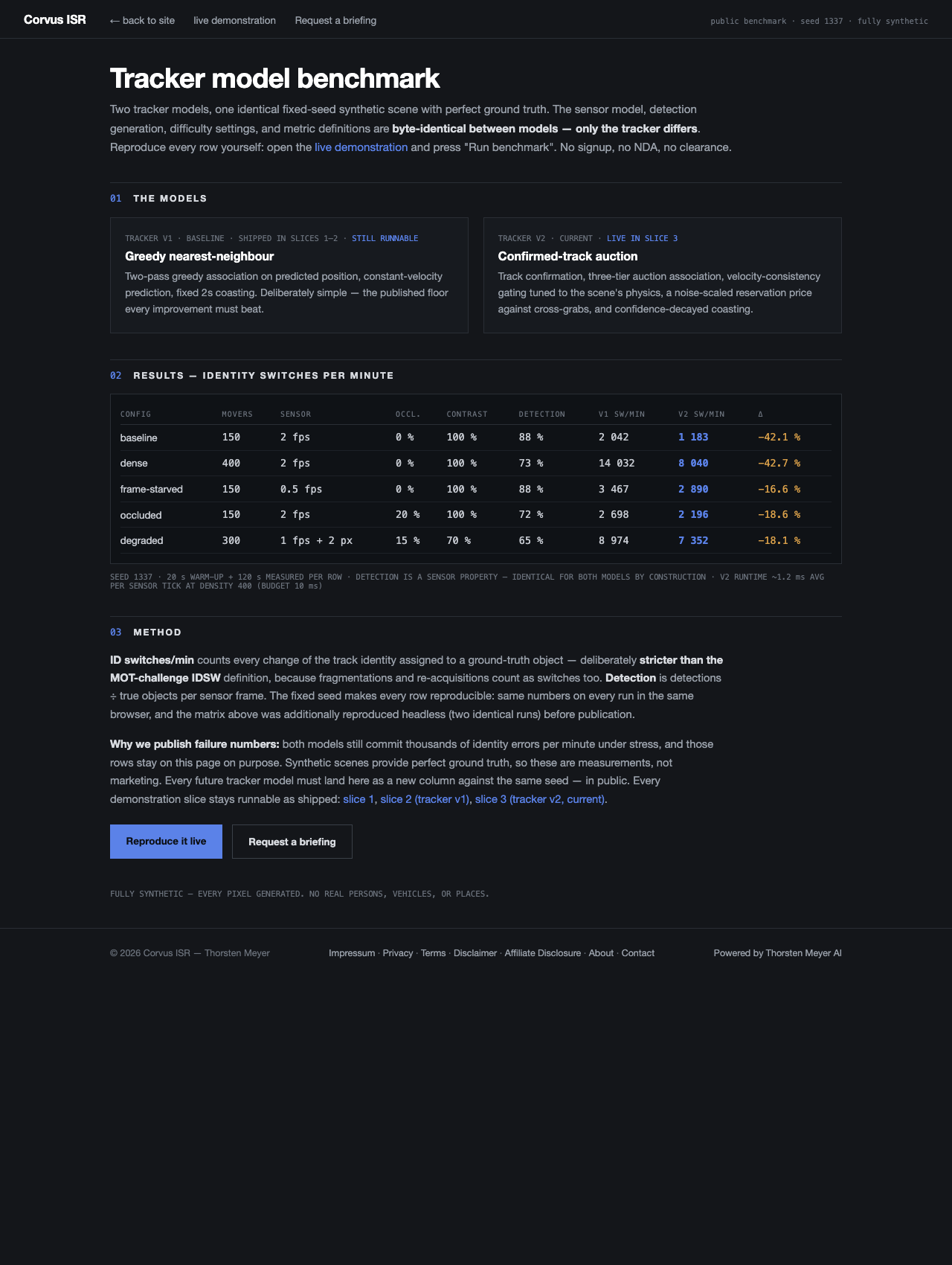
Corvus ISR, a leader in wide-area motion imagery (WAMI) exploitation, has released a detailed PUBLIC TRACKER BENCHMARK comparing its two tracker models using a synthetic scene with perfect ground truth. This approach ensures that the evaluation is objective, as the synthetic data is generated with exact pixel-level accuracy and no real-world variability. By maintaining identical conditions, the benchmark isolates the tracking algorithm performance from other sensor or detection factors, providing a clear view of each model’s capabilities.

Prime made for students and young adults
- Fast, free delivery for dorm and study essentials
- Prime Video and Amazon Music included
- Member-only deals
The first model, v1, employs a “greedy nearest-neighbour” strategy with simple assumptions: two-pass greedy association, constant-velocity prediction, and fixed 2s coasting. It serves as the published baseline, yet still demonstrates room for improvement. In contrast, the newer v2 model utilizes a “confirmed-track auction” with sophisticated features like three-tier auction association, velocity-consistency gating, and confidence-decayed coasting. This evolution in methodology is reflected in the benchmark results, which show significant performance gains.
The headline results reveal that, under a standard scenario with 150 moving objects at 2 frames per second, v1 registers approximately 2,042 ID switches per minute. The v2 reduces this figure by 42.1% to 1,183. Similar improvements are seen in dense scenarios with 400 objects, decreasing from 14,032 to 8,040 ID switches, a 42.7% reduction. Even under challenging conditions like frame-starvation at 0.5 fps, occlusion, or sensor degradation, v2 consistently outperforms v1, with reductions of roughly 18% in each case.
It’s important to note that the detection rate is a sensor property and remains identical across models by design. The benchmark’s emphasis on ID switch metrics, which count every change in track identity—even re-acquisitions and fragmentations—is intentionally strict. This rigorous approach underscores the importance of robust association algorithms beyond simple detection, encouraging transparency in performance claims.
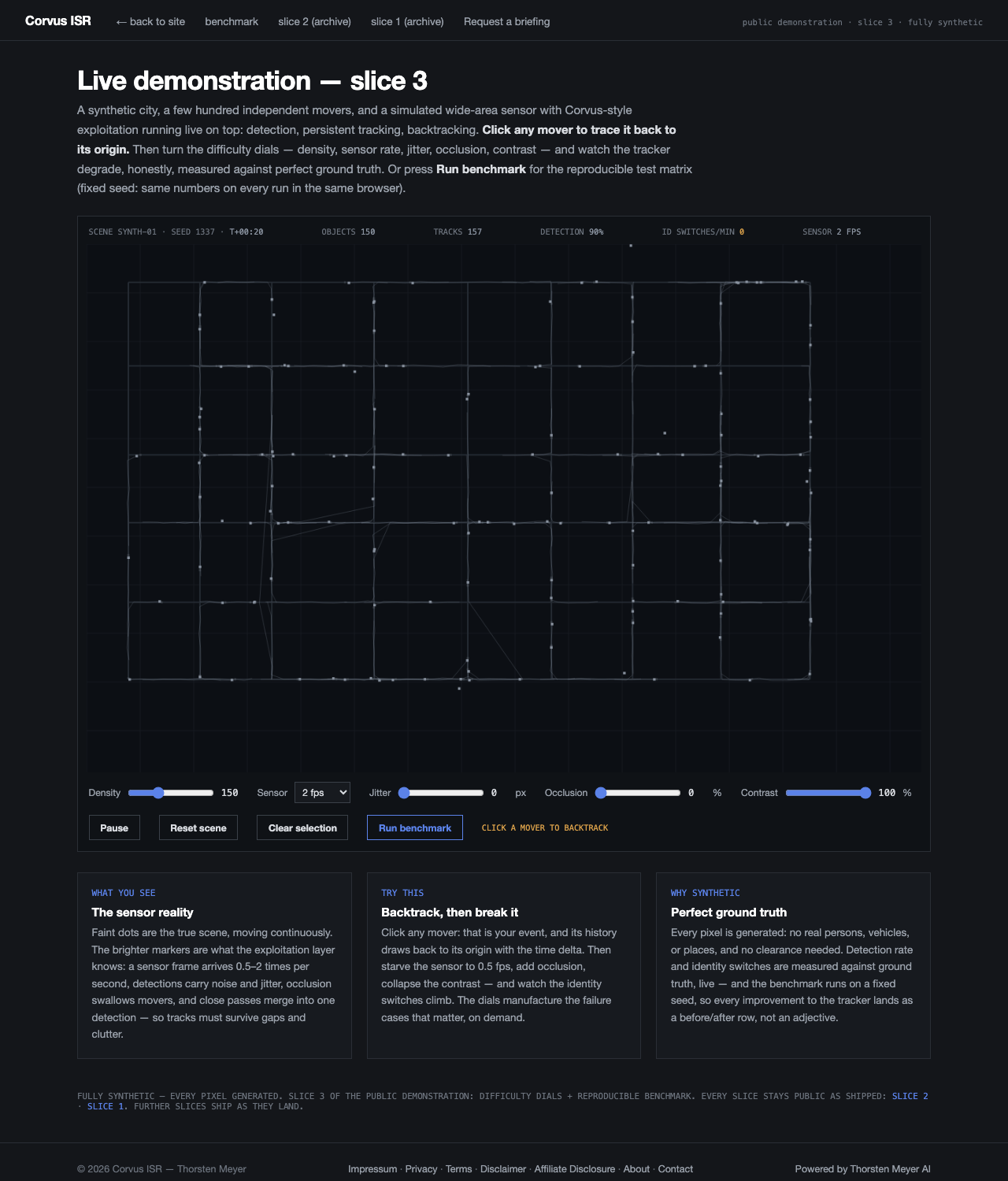
The reason Corvus ISR publishes such explicit failure numbers is to promote honest measurement. Both models still produce thousands of identity errors per minute under simulated stress, highlighting the ongoing challenge in tracking. Because the synthetic scenes offer perfect ground truth, these numbers are purely measurement-based, not marketing. They serve as a benchmark for future developments—every new tracker must be evaluated against this same fixed seed to demonstrate progress. As the adage goes, “Vendors who show only successes ask for faith; a published failure matrix asks for measurement.”
From an engineering perspective, v2 achieves real-time performance, averaging around 1.2 milliseconds per sensor tick at a density of 400 objects. Even in the worst case, it peaks at about 5 ms, well within a 10 ms processing budget. This demonstrates the feasibility of deploying advanced AI-driven tracking algorithms in live scenarios. Curious readers can reproduce it live—just open the demo, press “Run benchmark,” and see the results firsthand. No signup or NDA is required, making this an open opportunity for hands-on evaluation.
In conclusion, this synthetic benchmark methodology exemplifies how perfect ground truth can be leveraged to objectively evaluate tracking performance. By publishing detailed failure metrics, Corvus ISR promotes transparency and measurable progress in the field of motion tracking. If you’re interested in seeing how your own algorithms measure up, we invite you to run the benchmark yourself.
wide area motion imagery WAMI tracking system
As an affiliate, we earn on qualifying purchases.
As an affiliate, we earn on qualifying purchases.
Halloween Picks
halloween
As an affiliate, we earn on qualifying purchases.