Geometric symbols like hexagons and triangles carry deep meanings across cultures and nature. Hexagons symbolize harmony, balance, and interconnectedness, often seen in honeycombs and crystal structures, representing stability and efficiency. Triangles can signify aspiration and divine energy when pointing upward, or receptivity and femininity when downward. These shapes convey powerful ideas of unity, transformation, and strength. Continuing with this exploration reveals even more about the rich symbolism behind these simple forms.
Key Takeaways
- Hexagons symbolize harmony, interconnectedness, and stability, often representing efficiency and wholeness in nature and culture.
- Triangles represent aspiration, balance, and transformation, with upward points symbolizing divinity and downward points femininity.
- Both shapes are used in religious, architectural, and artistic contexts to convey themes of unity, strength, and spiritual connection.
- Hexagons frequently appear in natural structures like honeycombs and crystals, emphasizing natural efficiency and order.
- Triangles serve as versatile symbols for elements, divine concepts, and stability across various cultural and practical applications.
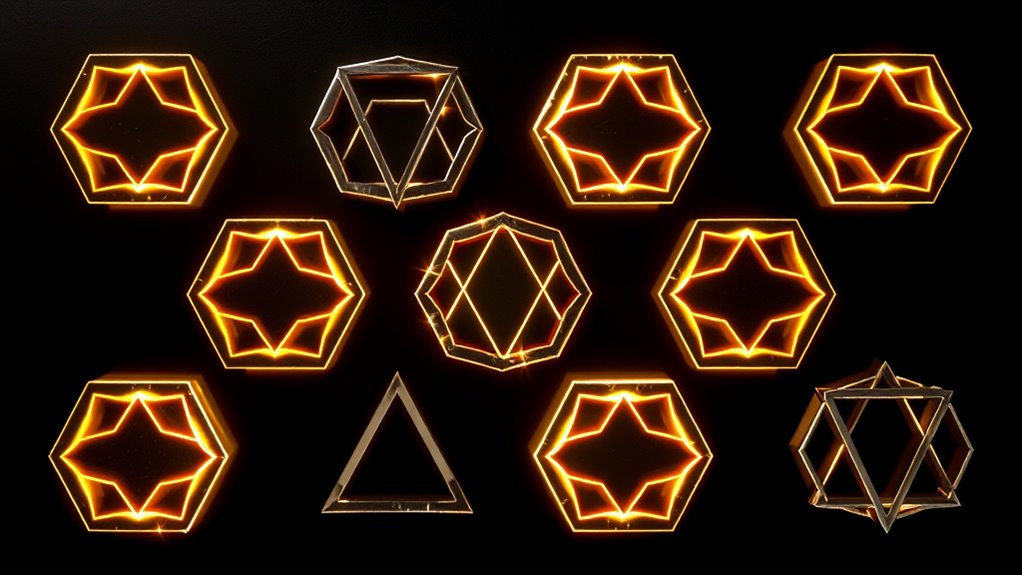
Geometric symbols are powerful visual tools that represent abstract ideas, concepts, and mathematical relationships through simple shapes like circles, triangles, squares, and lines. Among these, hexagons and triangles hold particular significance because their forms evoke rich symbolic interpretations and cultural meanings. When you encounter a hexagon, you might notice its six equal sides and angles, which often symbolize harmony, balance, and unity in various traditions. In nature, hexagons appear in honeycombs and crystal structures, reinforcing their association with efficiency and interconnectedness. In cultural contexts, the hexagon can symbolize the nexus of spiritual and material worlds, representing wholeness and the integration of different elements. Its symmetrical shape makes it a popular motif in architecture, art, and spiritual symbols, emphasizing stability and interconnectedness.
Triangles, on the other hand, are perhaps one of the most versatile geometric symbols you’ll come across. Their three sides and angles lend themselves to numerous symbolic interpretations. In many cultures, the upward-pointing triangle signifies aspiration, ambition, and the divine or masculine energy, while downward-pointing triangles symbolize receptivity, femininity, and the earth. You’ll find triangles in religious iconography, where they often represent the Holy Trinity or the threefold nature of existence. In alchemy and mysticism, triangles can denote elements like fire and water, emphasizing transformation and balance. The cultural significance of triangles extends beyond spiritual connotations; they also serve practical purposes in design and architecture because of their structural strength. When you see a triangle used in logos, flags, or art, it often emphasizes stability, strength, or dynamic movement, depending on its orientation.
Both hexagons and triangles have deep roots in cultural symbolism, which influences how they’re perceived and used today. Their symbolic interpretations can vary widely based on context, but their common thread lies in their ability to convey complex ideas through simple forms. You might notice that many traditional symbols, religious icons, and architectural elements employ these shapes to express ideas of harmony, power, or divine connection. Recognizing the cultural significance behind these shapes can deepen your understanding of their use in art, religion, and design. Whether you’re exploring a religious symbol, a piece of modern art, or a scientific diagram, understanding the symbolic interpretations of these geometric forms helps you see the underlying messages they communicate. In essence, hexagons and triangles aren’t just shapes; they are carriers of cultural stories, beliefs, and universal truths.

Ripeng 6 Pcs 11.8 Inch Boho Hexagon Wall Decor Farmhouse Wood Earthy Hexagon Wall Panels Modern Hollow Carved Design Rustic Abstract Decor for Living Room Kitchen Bedroom(6 Style)
Package Included: 6 distinctive wooden hexagon wall decor, each measuring 11.8 inches (30 cm) in diameter; These earthy…
As an affiliate, we earn on qualifying purchases.
As an affiliate, we earn on qualifying purchases.
Frequently Asked Questions
How Are Geometric Symbols Used in Modern Digital Design?
You use geometric symbols in modern digital design to create clear, recognizable icons that enhance interface aesthetics. These symbols, like hexagons and triangles, improve digital iconography by conveying ideas quickly and intuitively. They help you develop streamlined, visually appealing interfaces that guide users effortlessly. By incorporating geometric shapes, you guarantee your designs are both functional and stylish, making interactions more engaging and intuitive for users.
What Cultural Variations Exist in the Interpretation of Hexagons and Triangles?
You might think everyone sees hexagons and triangles the same way, but cultural symbolism and historical meanings tell a different story. In some cultures, hexagons symbolize harmony and balance, while others see them as divine or sacred. Triangles can represent strength, stability, or change depending on the region. So, your interpretation depends on where you come from, highlighting how symbols carry diverse meanings across the globe—ironic, isn’t it?
Are There Specific Colors Associated With These Geometric Symbols?
Yes, specific colors are often linked to geometric symbols through color symbolism and cultural associations. For example, in some cultures, red triangles symbolize energy or danger, while blue hexagons might represent stability or trust. Your interpretation depends on the context and cultural background, as colors can carry different meanings across societies. Pay attention to these associations when analyzing or designing symbols, as they influence perception and communication.
How Do Geometric Symbols Influence Spiritual or Religious Practices?
Imagine sacred geometry as a divine language, guiding your spiritual journey through ritual symbolism. When you incorporate geometric symbols like hexagons and triangles, you tap into universal patterns that deepen your connection to higher powers. These symbols influence your practices by representing harmony, balance, and spiritual awakening, serving as visual tools that elevate your rituals and foster a profound sense of unity with the cosmos.
Can Geometric Symbols Be Personalized for Individual Symbolism?
Yes, you can definitely personalize geometric symbols for individual meaning. By choosing specific shapes, patterns, or arrangements that resonate with your personal experiences or beliefs, you create a unique symbolism. This personalized symbolism can serve as a powerful reminder of your values, goals, or spiritual journey. It allows you to connect deeply with the symbol, making it a meaningful reflection of your individual story and aspirations.

Silver Recovery Symbol Charms, 4-Pack Sacred Geometry Triangle in Circle, Sobriety Recovery Jewelry Making Pendants
SACRED GEOMETRY SYMBOLISM: The triangle within a circle represents unity, recovery, and service, creating powerful symbols of personal…
As an affiliate, we earn on qualifying purchases.
As an affiliate, we earn on qualifying purchases.
Conclusion
So, next time you see a hexagon or triangle, don’t just shrug it off as simple shapes. They’re packed with meaning, history, and even a little mystery. But don’t worry, you’re now an expert—no need to overthink it. Just remember, these symbols are everywhere, quietly telling stories and guiding us. Who knew geometry could be so profound? Now go ahead, impress someone with your newfound “deep” understanding of basic shapes.

Taiyin 6 Pcs 12 Inch Wooden Sacred Geometry Wall Art Set, Zen Geometric Wall Decor for Home Meditation Room, Inspired Hanging Art with Metatron Cube, Flower of Life, Sri Yantra(Burlywood)
Wall Art Sets: you will receive 6 pieces of sacred geometry wall arts in 6 different styles, which…
As an affiliate, we earn on qualifying purchases.
As an affiliate, we earn on qualifying purchases.

Da Piao Liang Sacred Geometry Orgone Pendant Necklace with Metatron's Cube & Mandala Design – SBB Copper Wire Energy Amulet, Black Adjustable 26-Inch Cord Chain for Spiritual Healing
Sacred Energy & Spiritual Protection – Crafted with sacred geometry symbols including Metatron's Cube and Mandala, this orgone…
As an affiliate, we earn on qualifying purchases.
As an affiliate, we earn on qualifying purchases.