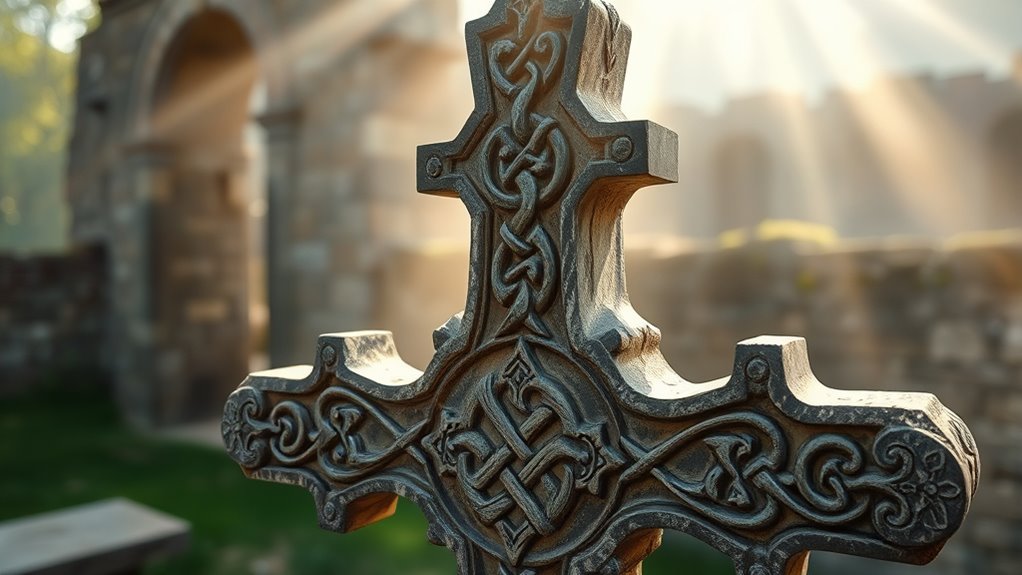

The Celtic Cross blends medieval craftsmanship with deep spiritual symbolism rooted in Christian and pagan traditions. You’ll notice its intricate knotwork and the circle at the center, representing eternity and interconnectedness. Historically, it’s a symbol of faith, life’s journey, and cultural identity, carved from stone and placed in sacred spaces. Its design continues to inspire as a powerful reminder of divine guidance and spiritual hope. Exploring further reveals the full meaning behind this enduring emblem.
Key Takeaways
- The Celtic Cross combines Christian symbolism with pagan origins, featuring a ring connecting the cross’s arms.
- It dates back centuries, representing faith, eternity, and spiritual interconnectedness through intricate knotwork and patterns.
- The circular ring symbolizes eternal life and divine unity, reflecting both spiritual beliefs and cultural identity.
- Crafted from stone with detailed carvings, it showcases medieval artistry and devotion in its design.
- Today, the Celtic Cross remains a powerful symbol of faith, cultural heritage, and spiritual hope.

Have you ever wondered about the meaning behind the Celtic Cross? This iconic symbol has captivated many with its intricate design and deep significance. Its origins trace back centuries, blending medieval artistry with profound spiritual symbolism that continues to resonate today. When you look at a Celtic Cross, you’re not just seeing a decorative piece; you’re witnessing a rich tapestry of history and faith woven into a single emblem. The cross’s circular ring, which connects the arms, is often interpreted as a symbol of eternal life and unity, emphasizing the interconnectedness of life, faith, and the divine. This circular element also reflects the influence of earlier pagan symbolism, which was embraced and transformed by Christian communities to convey a message of everlasting life through Christ.
The craftsmanship behind the Celtic Cross showcases medieval artistry at its finest. Its detailed knotwork, spirals, and interlacing patterns demonstrate the skill and devotion of artisans from the early medieval period. These designs are more than mere decoration—they serve as visual representations of spiritual concepts like interconnectedness and eternity. When you observe the intricate carvings, you can almost feel the careful craftsmanship that went into creating each piece, knowing it was meant to inspire and uplift those who saw it. The artistry was not only meant to beautify but also to serve as a spiritual tool, inviting reflection and meditation on divine truths. Many of these crosses were carved from stone and stood in prominent locations like churchyards or roadside shrines, making them accessible to the community and emphasizing their importance in daily spiritual life.
In essence, the Celtic Cross embodies a fusion of medieval artistry with spiritual symbolism, making it a powerful emblem of faith and cultural identity. Its design encapsulates the idea that life is an ongoing journey, with divine presence guiding every step. Whether you’re drawn to its artistic beauty or to its spiritual meaning, the Celtic Cross invites you to explore the depths of history and faith intertwined in its form. As you learn about its origins and symbolism, you’ll discover that this ancient symbol remains relevant — a testament to the enduring power of faith, craftsmanship, and cultural memory. The Celtic Cross isn’t just a relic of the past; it continues to inspire and symbolize spiritual hope for those who carry its meaning forward in their lives.
Frequently Asked Questions
How Does the Celtic Cross Differ From Other Christian Crosses?
You’ll notice the Celtic cross differs from other Christian crosses through its unique design variations and symbolic differences. It features a circle around the intersection, representing eternity and unity, which sets it apart from simple crosses. This circle embodies the endless love of God and adds a spiritual dimension. The intricate knotwork and detailed carvings further highlight its cultural significance, making it a distinctive symbol among Christian crosses.
What Are the Origins of the Celtic Knot Design?
You’ll find that the origins of the Celtic knot design trace back to ancient symbolism, used by early Celtic artisans. These intricate patterns showcase exceptional knot craftsmanship, with no beginning or end, symbolizing eternity and interconnectedness. You can see their influence in ancient Irish and Scottish artifacts, where the continuous loops reflect spiritual unity and the endless cycle of life, making them an essential part of Celtic culture and mysticism.
Is the Celtic Cross Used in Modern Spiritual Practices?
Yes, you’ll find the Celtic cross used in modern spiritual practices, especially in meditation symbolism and spiritual healing. People incorporate it as a tool to deepen their connection to spiritual traditions, seeking guidance and balance. Its design represents harmony and eternal life, making it a meaningful symbol in contemporary rituals. By meditating with the Celtic cross, you can enhance your spiritual journey and foster healing and inner peace.
Are There Regional Variations of the Celtic Cross?
You’ll notice regional variations of the Celtic Cross often appear where different cultural adaptations have influenced its design. For example, Irish crosses tend to have intricate knotwork, while Scottish versions might include unique symbols or inscriptions. These regional styles reflect local artistry and history, making each cross a distinct cultural artifact. So, as you explore, you’ll see how these regional styles add depth and diversity to this iconic symbol.
How Has the Celtic Cross Influenced Contemporary Jewelry Design?
You see how the Celtic cross has influenced contemporary jewelry design through its rich historical symbolism and modern adaptations. Designers incorporate the cross’s intricate knotwork and meaningful symbolism to create unique pieces that honor tradition while appealing to today’s style. Whether as pendants, rings, or earrings, the Celtic cross’s timeless design inspires personal expression and cultural pride, making it a popular motif in modern jewelry collections.
Conclusion
Now that you’ve explored the rich symbolism and history of the Celtic cross, you see it’s more than just a design. It’s a timeless emblem of faith, heritage, and resilience—kind of like how you might scroll through your favorite app today. Though centuries old, its meaning still resonates, reminding you of the enduring power of faith and tradition. So, next time you see one, remember—you’re looking at a piece of history that’s still alive in today’s world.