Choosing a science-themed educational kit is partly a choice about how a child will learn. Guided Experiment Kits provide materials and instructions for specific activities, such as testing acidity, growing crystals, or exploring magnetism. Open-Ended STEM Building Kits use components such as gears, circuits, connectors, or construction pieces to support projects with more than one possible result.

Prime made for students and young adults
- Fast, free delivery for dorm and study essentials
- Prime Video and Amazon Music included
- Member-only deals
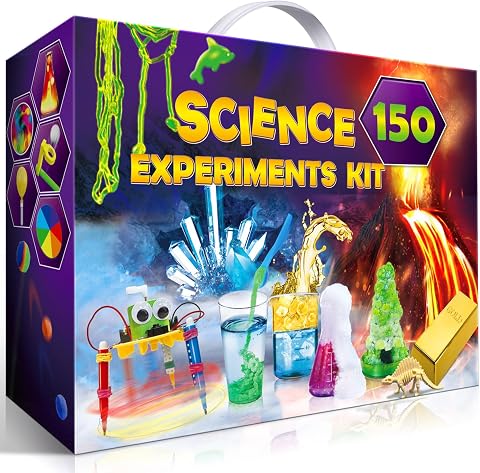
UNGLINGA 150-Experiment Science Kit for Kids
- ✔ Brand: UNGLINGA
- ✔ Experiment count: 150
- ✔ Recommended age: 8 years and up

National Geographic Science Magic Kit with 100+ Experiments for Kids 8-12
- ✔ Brand: Blue Marble / National Geographic
- ✔ Experiment count: 100+ total: 20 core and 85+ bonus
- ✔ Recommended age: 8 years and up

National Geographic Magic Chemistry Set with 10 Experiments for Kids Ages 8–12
- ✔ Brand: Blue Marble / National Geographic
- ✔ Experiment count: 10
- ✔ Recommended age: 8 years and up
The tradeoff is structure versus freedom. Guided kits make it easier to start an activity and connect observations to a science topic; building kits give children more room to make decisions, troubleshoot, and reuse parts in new projects. Choose guided experiments when a clear lesson and a manageable activity matter most. Choose an open-ended set when the child enjoys designing and rebuilding, and an adult can tolerate a less predictable process. The right choice also depends on age, supervision, the quality of the instructions, and whether the kit is likely to be used after its first few activities.
At a Glance
| Criteria | Guided Experiment Kits | Open-Ended STEM Building Kits | Winner |
|---|---|---|---|
| Getting started | Step-by-step activities give children a clear starting point | Children may need to choose a project before building | A |
| Learning emphasis | Direct focus on observing and learning a specific science concept | Emphasizes design, testing, mechanics, and problem-solving | Depends |
| Creative freedom | Usually bounded by the experiments and materials included | High; parts can support multiple designs and modifications | B |
| Repeat use | Good when activities vary; some experiments consume materials | Often high if parts are durable and compatible across projects | B |
| Adult support | Instructions help, though measuring or handling materials may need supervision | May require more adult help with planning or troubleshooting | A |
| Best age fit | Often suited to children who benefit from guided tasks; check the stated age range | Best for children ready to follow a design goal and revise a build | Depends |
| Value over time | Strong value when activities are complete, relevant, and reusable | Strong value when the parts support many projects and hold attention | Depends |
UNGLINGA 150-Experiment Science Kit for Kids
For families who want a kit that reaches beyond one science subject, UNGLINGA’s 150-experiment lineup is the most expansive starting point here. Its stated topics include chemistry, physics, earth science, and surface tension, so it can introduce children to different kinds of questions and activities rather than keeping the experience centered on chemical demonstrations. That breadth gives it the strongest claim to being a general science-themed educational kit in this comparison.The illustrated step-by-step manual is a practical advantage for children who need clear guidance as they work through an activity. Some experiments use common household items, which can make the kit adaptable, but it also means the box is not a complete supply source for every project. Compared with the National Geographic Magic Chemistry Set, UNGLINGA offers far more stated activities and wider subject coverage, but it does not foreground the same magic-trick performance element. Compared with the 100+ Science Magic Kit, its emphasis is general science variety rather than a large mix of illusions and household-based bonus experiments.We rank it first for buyers who value range across science topics. The tradeoff is that the experiment count should not be mistaken for 150 fully self-contained activities: some projects require items from home, and the provided details do not specify exactly which materials are supplied for every experiment. Choose it for variety and guided exploration; skip it if you want an entirely chemistry-focused kit or need every activity’s supplies included.
Pros:
- Lists 150 hands-on experiments across several science topics.
- Illustrated step-by-step manual supports guided activities.
- Some experiments use common household items.
- Covers chemistry, physics, earth science, and surface tension.
Cons:
- Some experiments require household items that are not included.
- The supplied details do not identify which materials are needed for each activity.
Best for: Children ages 8 and up who want to explore multiple science subjects with illustrated instructions.
Not ideal for: Buyers who want a chemistry-only set, a magic-performance format, or materials supplied for every activity.
Bottom line: We recommend UNGLINGA for the widest stated range of science topics, provided you are comfortable gathering some materials from home.
“We recommend UNGLINGA for the widest stated range of science topics, provided you are comfortable gathering some materials from home.”
National Geographic Science Magic Kit with 100+ Experiments for Kids 8-12
This kit makes the most sense for children who enjoy presenting an experiment as a trick and then learning what explains the effect. The main set contains 20 magic-style experiments, with a wand, white gloves, and an illustrated guide that explains the science behind the illusions. A bonus booklet adds more than 85 activities using household items, giving the kit two different modes: demonstrations supported by included materials, and a broader set that depends on what is available at home.Compared with the 10-experiment National Geographic Magic Chemistry Set, this one offers more core tricks and a much larger bonus activity collection. That extra range may suit a child who wants to keep exploring after the supplied experiments, but it brings more reliance on household supplies. UNGLINGA is the stronger match for learners who want activities across several named science fields; this kit’s appeal lies in the magic format and its explanations of scientific principles.The headline “100+” combines distinct kinds of activities: 20 core experiments with materials and more than 85 bonus experiments that use household items. Buyers should account for that split when deciding whether they need ready-to-go projects or are comfortable sourcing supplies. We place this behind UNGLINGA for general science breadth, but ahead of the smaller magic set for buyers who specifically want a longer magic-themed activity list.
Pros:
- Includes materials for 20 core experiments.
- Illustrated guide explains science behind the illusions.
- Wand and white gloves support the performance theme.
- Bonus booklet adds more than 85 household-item experiments.
Cons:
- Bonus activities depend on household items.
- The core theme is science magic rather than broad subject coverage.
Best for: Children ages 8 and up who like performing science demonstrations and can use household items for bonus activities.
Not ideal for: Buyers who want wide coverage across science subjects or a kit where all 100+ activities use supplied materials.
Bottom line: We recommend this kit for science-curious performers who want a substantial mix of supplied magic experiments and home-based follow-up activities.
“We recommend this kit for science-curious performers who want a substantial mix of supplied magic experiments and home-based follow-up activities.”
National Geographic Magic Chemistry Set with 10 Experiments for Kids Ages 8–12
Where the other two kits emphasize breadth, this set keeps its promise narrow: 10 chemistry experiments presented as magic tricks. Activities include instant snow, a floating coin, and color-changing liquids. The magic framing can give children a clear reason to watch closely, while the illustrated guide pairs kid-friendly instructions with explanations of the science behind each trick. Materials for the experiments, plus a wand and gloves, are listed as included.That focused format is its main advantage and its main limitation. Compared with the 100+ Science Magic Kit, it has far fewer activities and no stated bonus booklet of household experiments. In exchange, the buyer gets a more compact chemistry-centered selection without the same split between core tricks and a large home-supply collection. UNGLINGA is a better fit for children who want chemistry alongside physics and earth science; this set is more appropriate when the goal is a manageable introduction to chemistry demonstrations.We rank it third because its subject and activity range is the narrowest of the three, not because the focused approach is a weakness for every child. It can be the right choice when a child is drawn to chemistry and a small set of showable experiments. Skip it if you want a long-running activity collection or a kit that samples several scientific disciplines. Its age guidance is 8 years and up, so it is not presented as a kit for younger children.
Pros:
- Includes materials for 10 chemistry experiments.
- Magic-trick format makes demonstrations presentation-friendly.
- Illustrated guide explains the science behind each trick.
- Includes a wand and gloves.
Cons:
- Offers fewer activities than either other kit in this comparison.
- Focuses on chemistry and magic rather than a broad range of sciences.
Best for: Children ages 8 and up who want a concise, chemistry-focused set of demonstrations with a magic theme.
Not ideal for: Buyers seeking many activities, multiple science subjects, or a large collection of bonus experiments.
Bottom line: We recommend this set when a child wants a focused chemistry sampler and a performance element matters more than activity count.
“We recommend this set when a child wants a focused chemistry sampler and a performance element matters more than activity count.”
As an Amazon Associate we earn from qualifying purchases.
Key Differences
The biggest difference is what the kit asks a child to do. A guided experiment kit supplies the question and a sequence of steps; the child follows the procedure, observes what happens, and considers why. This makes a kit easier to use for a short, focused activity and can help an adult connect the materials to a lesson. The limitation is that the activity may have one intended outcome, and some experiments use up their ingredients or components.
An open-ended STEM building kit shifts more decisions to the child. A project may start with a challenge, but the child chooses how to build, tests whether the design works, and changes it when it does not. That flexibility can keep reusable parts in play longer, but it does not automatically teach a science idea: the child may need prompts to make a prediction, compare results, or explain what changed. For many families, the deciding factor is whether they want a ready-to-run lesson or a kit that invites ongoing projects.
Detailed Comparison
Getting started (Guided Experiment Kits wins — moderate)
Guided Experiment Kits win by a moderate margin for children who want to begin promptly. A sequence of steps reduces the time spent deciding what to do and can make a session feel achievable. Building kits can be just as accessible when they include clear starter challenges, but an open box of parts may leave a child unsure where to begin. In practice, choose A for short, planned activities; choose B when the child enjoys inventing a project from a prompt.
Learning emphasis (moderate difference)
Neither format wins for every learning goal. Guided experiments have the advantage when the goal is a particular concept, because a well-designed activity links materials, observations, and an explanation. Building kits are stronger for applying ideas through design, testing, and iteration, especially when the child can compare versions of a build. The difference is moderate: A favors focused investigation, while B favors learning through making. A kit’s topic and instruction quality matter more than its label.
Creative freedom (Open-Ended STEM Building Kits wins — major)
Open-Ended STEM Building Kits win by a major margin. Their components are intended for different combinations, so children can alter a design, invent a new one, or set their own challenge. Guided experiments can still invite predictions and variations, but the instructions often define the activity and expected result. Choose B when independent choices are the point; choose A when a defined outcome will help the child stay engaged.
Repeat use (Open-Ended STEM Building Kits wins — moderate)
Building kits usually win by a moderate margin when parts can be reused across projects. A durable set of connectors, gears, or circuit components may support many builds, while a single-use experiment can end when its consumable materials run out. Guided kits narrow the gap if they include numerous activities, reusable tools, and ideas for changing variables. Before buying either format, check which supplies are included, which must be replaced, and whether the instructions offer activities beyond the first few.
Adult support (Guided Experiment Kits wins — moderate)
Guided Experiment Kits generally win by a moderate margin because their steps help adults explain what to do next. That does not make every experiment independent: younger children may need help measuring, handling materials, or cleaning up. Open-ended kits can demand more adult involvement when a child needs help choosing a challenge or working through a stalled design. An experienced young builder may prefer that freedom; a family seeking a simple shared activity may find A easier to manage.
Age and confidence fit (moderate difference)
This is a genuine tie because both formats vary widely. A guided kit can suit a beginner if the reading, steps, and materials match the child’s age and abilities. A building set can suit the same child if it includes simple starter projects and components that are easy to handle. Older or more confident children may appreciate the independence of B, while a complex experiment kit may still need adult supervision. Use the manufacturer’s age guidance as a starting point, then consider reading, dexterity, patience, and adult availability.
Value over time (moderate difference)
There is no automatic value winner. Building kits can justify a higher price when their parts are durable, reusable, and varied enough to support many projects. Guided kits can be better value when they provide a coherent series of activities, useful tools, and clear explanations at a lower total cost. Count replacement materials and compare the number of genuinely distinct activities, rather than relying on the number printed on the box. Pay more for B only when its component range matches the child’s interests and supports continued experimentation.
Guided Experiment Kits: Pros and Cons
Pros:
- Clear steps make it easier to begin
- Activities can teach a specific concept directly
- Useful for short sessions with a defined goal
- Instructions can help adults guide the activity
Cons:
- Some experiments use materials that need replacing
- The expected result can limit experimentation
- Interest may fade if the kit contains few distinct activities
Open-Ended STEM Building Kits: Pros and Cons
Pros:
- Parts can support many designs and challenges
- Encourages testing, revision, and independent choices
- Reusable components can extend the kit’s useful life
- Fits children who prefer making things to following procedures
Cons:
- A child may need help deciding what to build
- Open-ended play can make the science lesson less explicit
- A stalled project may require adult troubleshooting
Who Should Choose What
Choose Guided Experiment Kits if:
- You want a ready-to-run activity with a clear science topic
- The child is new to experiments and benefits from step-by-step guidance
- You prefer short projects with a visible outcome
- You want instructions that help an adult support the lesson
Choose Open-Ended STEM Building Kits if:
- The child likes building, tinkering, and changing designs
- You want reusable parts for projects beyond a fixed activity list
- The child enjoys solving open-ended challenges
- You are willing to help turn building into reflection about what worked and why
Skip both if: Skip both if the kit’s age range, reading level, supervision needs, or replacement supplies do not fit your household; choose a simpler activity using materials and guidance already available.
Value for Money
Paying more for a building kit is worthwhile when the extra cost buys durable, versatile parts that the child will use across many projects. The price alone does not guarantee value: a large set can still sit unused if the child needs more structure than it provides. A guided kit may be the better purchase when it delivers several complete, well-explained experiments and the child wants a new activity rather than an open-ended supply of parts.
Compare the total expected cost: included materials, replacement supplies, and whether components can be used again. For a child who enjoys designing and rebuilding, a higher-priced open-ended kit can offer more use over time. For a beginner who wants a clear activity and a specific science topic, a less expensive guided kit may be the smarter value. Pay more only for features that match the child’s actual interests and the time available for adult support.
Final Verdict
For most families choosing a first science activity, Guided Experiment Kits are the safer starting point: they make the next step clear and tie an activity to a defined topic. Choose one with several distinct experiments and reusable tools so the experience does not end after a single result. Move toward an open-ended set when the child already enjoys tinkering or regularly asks to build their own solutions.
Open-Ended STEM Building Kits are the stronger choice for sustained creative projects and children who learn by making, testing, and revising. The deciding factor is the kind of independence the child enjoys: following a procedure to find out what happens, or choosing a design and improving it. If you can buy only one, pick the format the child is more likely to return to, and check the age guidance, materials, and adult support needs before deciding.
Frequently Asked Questions
Which kind of science kit is better for a beginner?
A guided experiment kit is often easier to start with because it supplies a sequence and a defined activity. A beginner who already likes construction may do better with a building kit that includes starter challenges. Match the instructions and materials to the child’s age and abilities.
Do open-ended building kits teach science?
They can teach science through building, testing, and changing a design, but the lesson may need prompting. Ask the child what they predict, what happened, and what they would change. A guided experiment kit usually makes the intended topic more explicit.
Are experiment kits worth buying if some supplies run out?
They can be, if the kit offers enough distinct activities and explains the concepts clearly. Check which materials are consumable, whether replacements are easy to find, and how much of the kit remains useful afterward. Reusable tools add value even when individual ingredients do not.
Should I pay more for a larger STEM building set?
Pay more when the set adds durable parts and project variety the child will use. A larger box is poor value if it lacks suitable instructions or overwhelms the child. Compare the actual projects, compatibility, and likely repeat use before paying extra.