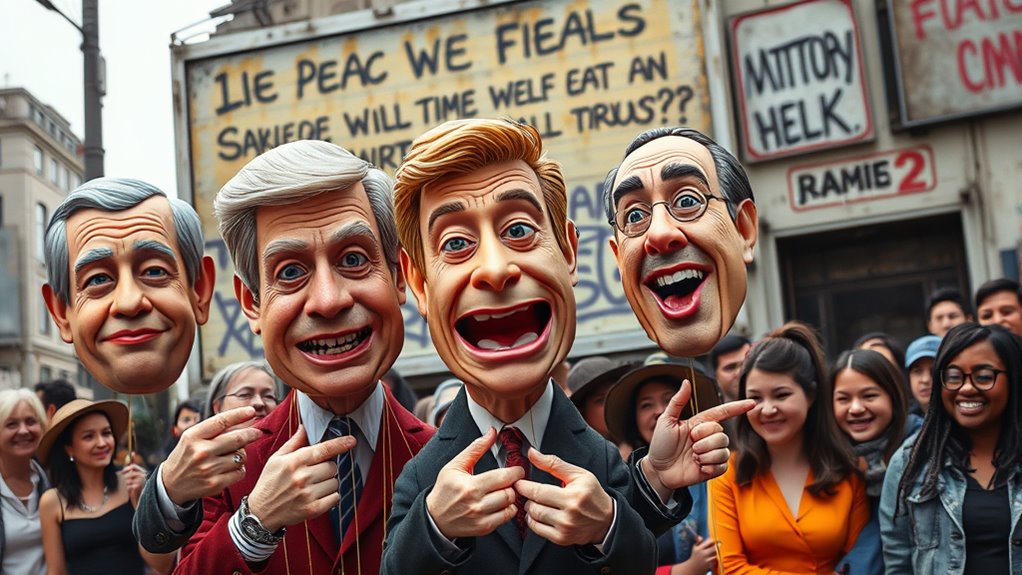

Satire in literature uses humor and irony to critique society, exposing flaws, hypocrisy, and injustices. It allows you to see serious issues in a more engaging way, often pushing boundaries that straight criticism cannot. Through clever exaggeration and playful poking fun at authority, satire invites you to reflect on societal norms and question power structures. Keep exploring to uncover how this powerful tool continues to challenge and inspire societal change.
Key Takeaways
- Satire employs humor and irony to criticize societal flaws and injustices within literary works.
- It simplifies complex social issues into witty, engaging observations that provoke reflection.
- Techniques like exaggeration and irony expose hypocrisy and challenge authority indirectly.
- Satire encourages critical thinking by revealing societal absurdities through entertainment.
- It serves as a powerful tool for social critique, prompting societal reflection and potential reform.
Have you ever wondered why writers use humor and irony to criticize society? The answer lies in how satire serves as a powerful tool for political critique and social commentary. When you read satirical works, you’re not just experiencing humor; you’re engaging with pointed observations about the flaws, contradictions, and injustices within society. Satire takes complex issues—like corruption, inequality, or hypocrisy—and distills them into sharp, often witty commentary that makes you think while also making you laugh. This combination of humor and critique makes it easier for writers to highlight serious problems without alienating their audience or sounding overly preachy. Instead, they create a space where audiences can reflect on societal issues in a way that feels engaging and accessible.
Satire uses humor and irony to highlight society’s flaws and inspire critical reflection.
By using irony and satire, writers can push boundaries that more straightforward forms of critique might avoid. They can poke fun at those in power or question societal norms without directly confronting authority, which often helps their messages reach a broader audience. This indirect approach also allows for layered meanings—what seems like a joke on the surface might carry a deeper, more serious message beneath it. Through clever exaggeration or satire, writers can expose hypocrisy and corruption more vividly, making their social commentary resonate deeply. This method also empowers readers to question what they accept as normal, encouraging critical thinking about political systems and social structures.
Satire’s effectiveness hinges on its ability to entertain while delivering a pointed critique. You might find yourself chuckling at a humorous portrayal of a corrupt politician, only to realize that the humor underscores the severity of their misconduct. This duality makes satire a unique form of social commentary, one that can spark conversations and challenge the status quo. Writers often use satire to challenge societal complacency by highlighting issues that are often overlooked or ignored. Their goal isn’t just to amuse but to inspire change. When you encounter satirical works, you’re invited to see the world through a different lens—questioning authority, examining societal values, and recognizing the flaws that might otherwise go unnoticed.
In essence, satire is a mirror held up to society, reflecting its absurdities and injustices with humor and wit. It’s a form of critique that engages you actively, prompting you to think critically about the world around you. By blending entertainment with insightful social commentary and political critique, satire becomes a powerful voice for change. It reminds you that humor isn’t just a distraction but a strategic tool for revealing truth and inspiring reflection.
Top picks for "satire humor critique"
Open Amazon search results for this keyword.
As an affiliate, we earn on qualifying purchases.
Frequently Asked Questions
How Does Satire Differ From Parody?
You’ll notice satire differs from parody in tone and intent. Satire aims to criticize or expose flaws, often using humor to provoke thought or change. It’s serious in its goal, even if humorous. Parody, however, mimics a style or work to entertain or mock, usually with a playful or exaggerated tone. While satire seeks social critique, parody simply lampoons or imitates for comic effect.
What Are the Most Famous Satirical Works in History?
You might not realize it, but some of the most famous satirical works in history, like Jonathan Swift’s “A Modest Proposal” and George Orwell’s “Animal Farm,” are hidden gems of political critique and social commentary. These works cleverly expose societal flaws, making you think critically about issues like inequality and corruption. Their enduring impact shows how satire can challenge perceptions, inspiring change through humor and sharp insight.
Can Satire Be Effective Without Humor?
Yes, satire can be effective without humor if it relies on serious critique and emotional impact. You can provoke thought and inspire change by presenting a stark, direct critique that resonates deeply with your audience. While humor often makes satire accessible, a serious tone can still drive home powerful messages, fostering reflection and awareness. Ultimately, the effectiveness depends on your ability to connect emotionally and challenge perceptions without relying solely on humor.
How Do Authors Decide What to Satirize?
Like a skilled archer, you target what sparks your passion or outrage. You decide what to satirize based on cultural commentary and political critique, choosing subjects that reveal societal flaws or hypocrisies. Your goal is to provoke thought and spark change, so you focus on issues that resonate with your audience. By highlighting these topics, you use satire as a mirror, reflecting society’s follies for all to see.
What Are the Risks of Using Satire in Literature?
You risk crossing offensive boundaries or provoking political repercussions when using satire in literature. If your critique hits too close to home or targets sensitive issues, readers might feel offended or even retaliate legally or socially. Satire can backfire if not handled carefully, leading to misunderstandings or damaged reputations. To avoid this, you need to balance sharp critique with sensitivity, ensuring your humor doesn’t alienate or harm your audience.
Conclusion
You might think satire’s just about making fun, but it’s actually a powerful tool for change. Some say it exposes truths hidden behind humor, forcing you to see flaws you’d otherwise ignore. If you believe satire’s only entertainment, you’re missing its real strength—challenging perspectives and sparking reflection. So next time you laugh at satire, remember, it’s often doing more than just amusing; it’s quietly shaping minds and society.