The Tree of Life in esoteric traditions symbolizes the interconnectedness of all existence and guides spiritual growth. Its roots ground you in origin and unseen forces, while the branches reach toward higher understanding and expansion. This dynamic symbol reflects growth, balance, and the ongoing process of spiritual evolution. By exploring its deeper layers, you can learn how it embodies universal truth and personal transformation, inviting you to discover more about its profound meanings as you continue exploring.
Key Takeaways
- The Tree of Life symbolizes the interconnectedness of the universe and the human soul across various esoteric traditions.
- It often represents a map of spiritual paths, containing multiple levels of consciousness and divine principles.
- In Kabbalah, the Tree of Life comprises ten sefirot, depicting divine emanations and the process of creation.
- Esoteric teachings emphasize balancing inner grounding (roots) with outward spiritual exploration (branches).
- The Tree functions as a dynamic, living symbol for growth, integration, and ongoing spiritual development.
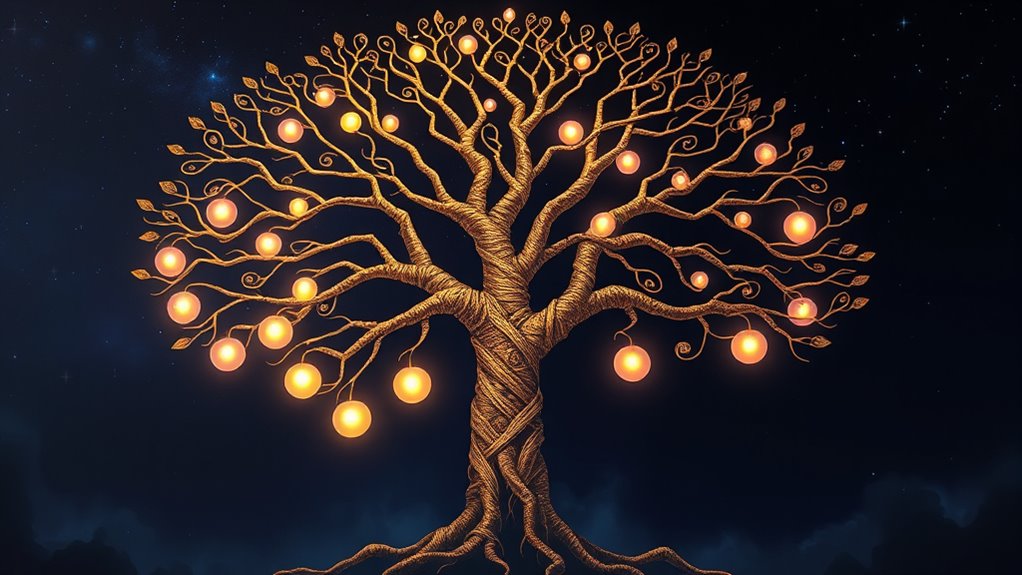
Have you ever wondered how ancient esoteric traditions depict the interconnectedness of the universe and the human soul? The Tree of Life serves as a powerful symbol across many spiritual paths, illustrating how everything is woven into a single, intricate web. At its core, this symbol emphasizes that the universe isn’t a random collection of separate entities but a unified whole. When you look at the Tree of Life, you see the symbolism of roots and branches, each holding deep meaning. The roots dig deep into the earth, anchoring and grounding the tree, representing your origin, subconscious, and the hidden energies that sustain life. They remind you that your foundation lies in ancient wisdom, traditions, and the unseen forces that support your growth. The roots symbolize stability, nourishment, and the connection to the primal energies that fuel your spiritual development. Conversely, the branches stretch upward and outward, symbolizing the expansion of wisdom, consciousness, and your journey toward higher understanding. These branches are like the pathways of knowledge you explore as you seek enlightenment, each one representing different facets of spiritual insight. Together, the roots and branches form a complete system—showing that your spiritual evolution depends on a balanced relationship between your inner grounding and your outward expansion.
This interconnectedness teaches you that growth requires both humility and aspiration. The roots remind you to stay connected to your origins, your core beliefs, and the foundational truths that anchor you. The branches, on the other hand, challenge you to reach beyond your comfort zone, exploring new ideas, philosophies, and domains of consciousness. The symbolism of roots and branches also echoes the esoteric idea that everything in the universe is linked; your personal journey reflects the cosmic order. As you nurture your roots, you deepen your understanding of yourself and the universe, recognizing that your spiritual evolution is rooted in ancient wisdom but also reaches toward future enlightenment. The Tree of Life, thus, isn’t just a static image—it embodies the dynamic process of growth, integration, and connection. It encourages you to honor your origins while continuously expanding your awareness. Whether through meditation, study, or introspection, you’re invited to see yourself as part of this grand, interconnected system—where every root and branch plays a crucial role in your spiritual unfolding.
Top picks for "tree life esoteric"
Open Amazon search results for this keyword.
As an affiliate, we earn on qualifying purchases.
Frequently Asked Questions
How Does the Tree of Life Relate to Modern Spiritual Practices?
You can see the Tree of Life as a tool for symbolic integration in modern spiritual practices, helping you connect different aspects of yourself and your journey. It encourages spiritual growth by providing a visual map of your inner development, guiding you through various levels of consciousness. By meditating on its symbolism, you deepen your understanding, fostering transformation and a more profound connection to your spiritual path.
Are There Different Versions of the Tree of Life Across Traditions?
Yes, there are different versions of the Tree of Life across traditions. You’ll find cultural variations where the structure and symbolism change, reflecting unique spiritual beliefs. Mythological representations often depict it as a sacred axis or a cosmic connection, adapting to each tradition’s worldview. These differences help you see how various cultures interpret spiritual growth, divine connection, and the universe through their own symbolic trees.
What Are the Historical Origins of the Tree of Life Symbolism?
You might think the Tree of Life just popped up in fancy spiritual books, but nope—its roots dig deep into ancient symbolism. You see, cultures worldwide, from Mesopotamia to Egypt, used it as a powerful metaphor for creation and interconnectedness. These diverse interpretations reveal how humans, across ages, have visualized life’s origins, blending mythology and spirituality, making it a timeless symbol that’s evolved but never lost its mystique.
How Is the Tree of Life Used in Meditation or Ritual?
During meditation or ritual, you use the Tree of Life as a tool for meditative visualization, focusing on its interconnected nodes and pathways to deepen your spiritual awareness. It serves as ritual symbolism, helping you connect with universal energies and inner wisdom. Visualize yourself ascending or descending its branches, aligning your energy with its symbolism, which enhances your spiritual journey and brings clarity, balance, and insight into your practice.
Can Studying the Tree of Life Improve Personal Development?
Studying the Tree of Life acts like planting a seed in your mind, fostering personal growth and self-awareness development. You might find that exploring its interconnected spheres helps you understand your strengths and challenges better. For example, as you deepen your knowledge, you become more conscious of your habits and thought patterns, enabling you to make meaningful changes. Ultimately, it’s a powerful tool for cultivating insight and fostering ongoing personal transformation.
Conclusion
As you explore the Tree of Life across esoteric traditions, you’ll find it’s more than just a symbol—it’s a map of spiritual ascent. Remarkably, over 80% of mystical systems incorporate some form of the Tree, highlighting its universal significance. Whether in Kabbalah, Hermeticism, or other teachings, this sacred diagram guides your journey toward enlightenment. Embrace its lessons, and you’ll discover a profound connection between the earthly and the divine.