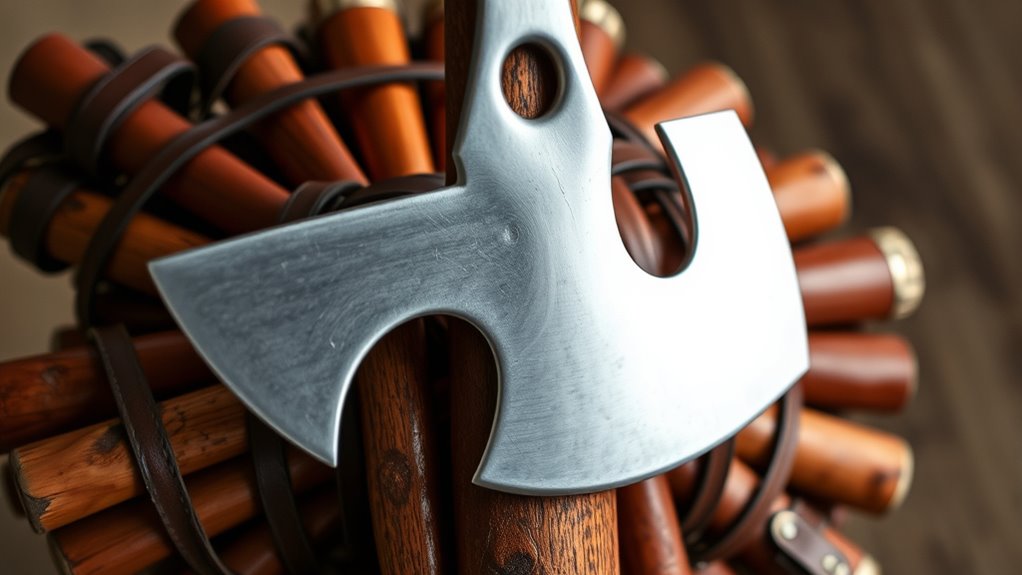

The fasces is an ancient Roman symbol that represents authority, unity, and strength. It features a bundle of rods bound together, with an axe symbolizing law enforcement and justice. When you see it, it’s a reminder that power comes from collective effort and shared responsibility, not just individual rule. Today, the fasces still appears in symbols of government and authority, showing how its meaning endures across history. If you explore further, you’ll uncover more about its lasting significance.
Key Takeaways
- The fasces symbolizes authority, unity, and strength rooted in Roman history.
- It represents collective power, with bundled rods signifying strength through unity.
- Carried by officials, it signified legal authority and enforcement of laws.
- The inclusion of an axe symbolizes justice and law enforcement power.
- Its enduring legacy appears in modern symbols of governance, emphasizing responsible authority.
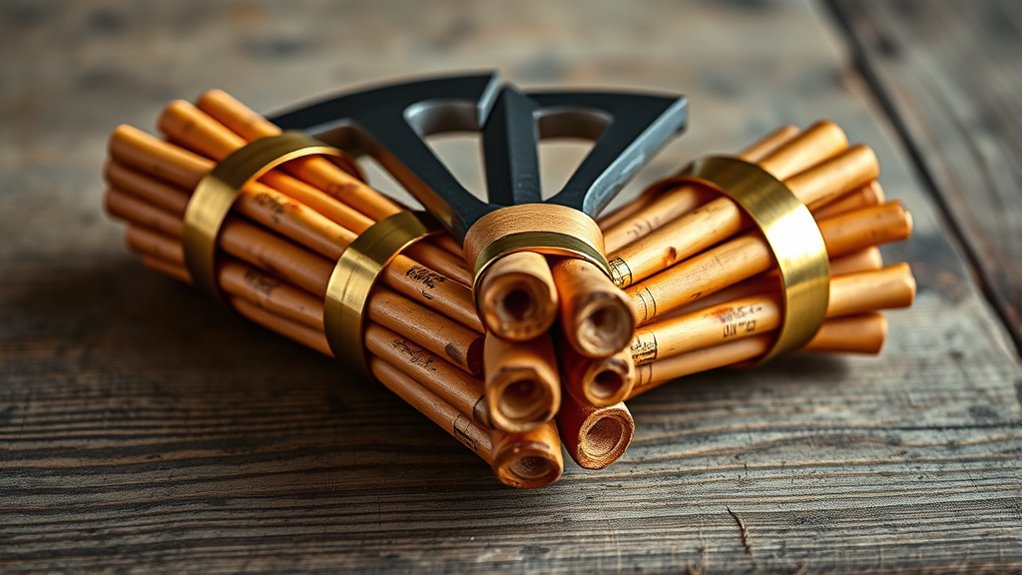
Have you ever wondered what the fasces symbolize in Roman history? If you’ve come across this striking emblem, you’ll notice it’s more than just a bundle of rods with an axe. It’s a powerful symbol rooted in ancient symbolism, representing authority, unity, and strength. In ancient Rome, the fasces served as a visual reminder of political authority, embodying the idea that power isn’t held by individuals alone but by a collective force that maintains order. When Roman officials carried the fasces, it signified their official capacity to enforce laws and command respect, making it a key element of political authority in Roman society.
The fasces symbolize the concept that strength is derived from unity. The individual rods are fragile on their own, but when bound together, they become a formidable bundle. This imagery was deliberate, emphasizing that Rome’s stability depended on the unity of its people and institutions. The axe, which was sometimes included in the bundle, represented the power to execute justice or enforce law, but only wielded by those with proper authority. This combination of rods and axe made the fasces a potent emblem of legitimate power and responsibility, signifying that authority must be exercised with restraint and purpose.
In Roman politics, the fasces were more than mere symbolism—they were a tangible sign of authority carried by magistrates, consuls, and other officials. When a magistrate appeared with the fasces, it indicated that they held the legal power to command, punish, or enforce. It was a visual cue that authority was not arbitrary but rooted in the collective trust of Roman institutions. Over time, the fasces became an enduring symbol of political authority, influencing later symbols of governance and state power.
Today, the fasces continues to resonate as a symbol of authority and unity. Its influence extends beyond ancient Rome, appearing in modern coats of arms, government seals, and national symbols. This enduring legacy underscores its role as a reminder that true authority is rooted in collective strength and shared responsibility. When you see the fasces, you’re witnessing a symbol that encapsulates the core principles of ancient symbolism—power, unity, and legitimate authority—values that still underpin political life today. The fasces remind us that authority isn’t just about holding power but about serving the collective good through strength and unity.
Top picks for "fasc roman symbol"
Open Amazon search results for this keyword.
As an affiliate, we earn on qualifying purchases.
Frequently Asked Questions
How Did the Fasces Influence Modern Political Symbols?
You can see how the fasces influence modern political symbolism by recognizing its representation of Roman authority and unity. Many countries, like Italy and the United States, incorporate the fasces into their emblems, emphasizing strength and governance. Its design, with bundled rods and an axe, symbolizes authority and the power to enforce laws, making it a powerful icon that continues to evoke notions of political authority today.
Were Fasces Used in Any Other Ancient Civilizations?
You might think the fasces were unique to Rome, but they appeared elsewhere in ancient civilizations. Ancient Greek and Egyptian artifacts show similar symbols of authority, like bundled sticks and staffs representing power. These images, like a tapestry of history, reveal that the concept of unity and strength through bundled symbols wasn’t exclusive to Rome. So yes, other civilizations used similar symbols to signify leadership and authority.
What Materials Were Traditionally Used in Making Fasces?
You’ll find that fasces were traditionally made using wooden sticks, usually bundled together tightly. Metal bands were then wrapped around the sticks to hold them securely in place. This combination of materials made the fasces durable and symbolically powerful, representing authority and strength. The wooden sticks provided a sturdy core, while the metal bands guaranteed the bundle stayed intact, making the fasces a practical yet symbolic object.
How Did the Symbolism of Fasces Change Over Time?
Imagine a bundle of rods bound tightly, symbolizing unity and strength—this visual introduces the fasces’ changing symbolism. Over time, its cultural significance evolved from representing Roman authority to embodying authority, justice, and power in modern symbols like Italy’s republic. Its symbolic evolution reflects shifting political ideals, transforming from a tool of oppression into a sign of national sovereignty and unity, resonating with new ideals while honoring its historical roots.
Are Fasces Still Used in Any Official Government Capacities Today?
You’ll find that fasces are rarely used in modern government insignia today, as their association with fascist symbolism makes them controversial. Some countries, like Italy, have reintroduced the fasces in official capacity, but it’s often debated due to its historical ties. Generally, governments avoid using fasces to prevent misinterpretation, recognizing their potential to evoke fascist symbolism rather than emphasizing their original Roman significance.
Conclusion
So, next time you see the fasces, remember it’s more than just a bundle of rods; it’s a powerful symbol of authority and unity. Some might think it’s outdated or just ancient history, but it still represents strength through solidarity. Imagine holding a bundle of sticks tightly bound together—you can’t easily break them, just like how a united authority holds power. The fasces reminds us that strength comes from unity and shared purpose.