
TL;DR
Vesuvius Challenge participants Liam Warner and Nicola Bodill have recovered readable Greek text from PHerc. 306B using images made from micro-CT scans. The result won a $50,000 First Letters Prize and helps identify the scroll fragment’s position in the original roll, though the short reading does not yet establish the work’s author or full subject.
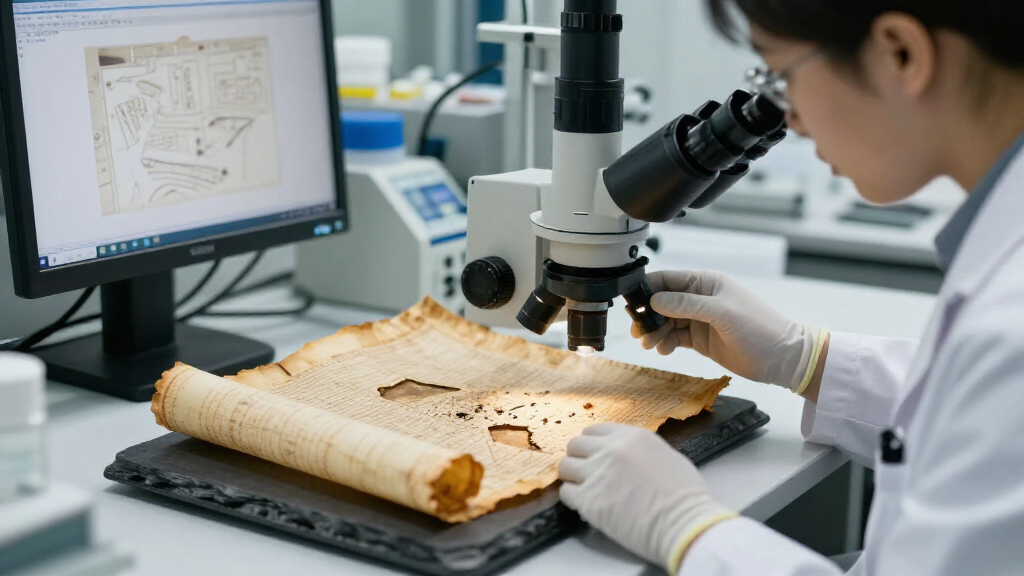
Liam Warner and Nicola Bodill have recovered a readable sequence of ancient Greek letters from PHerc. 306B, a carbonized scroll buried in the AD 79 eruption of Mount Vesuvius. The Vesuvius Challenge awarded them its $50,000 First Letters Prize after its papyrology team agreed that their image showed letters that earlier submissions could not establish with sufficient confidence.

Prime made for students and young adults
- Fast, free delivery for dorm and study essentials
- Prime Video and Amazon Music included
- Member-only deals
The result came after the Vesuvius Challenge reviewed 25 submissions focused on PHerc. 306. The scroll is divided into two portions, called PHerc. 306A and PHerc. 306B. According to the challenge, no one had read writing in the scroll since it was excavated in the 1750s, despite its micro-CT scanning the previous year. The scroll is held at the Biblioteca Nazionale di Napoli.
The prize criteria called for 10 readable characters within a four-square-centimeter area. Several competitors examined the same passage and recovered seven, eight or nine characters, but did not meet the target. The winning work made a faint stroke clearer, allowing the project’s papyrology team to agree on the Greek letters ΑΙ where earlier readings had differed between mu and nu.
The Challenge identifies the resulting sequence as τὸ δι᾽ αὑτὸ αἱρετόν, translated as “that which is in itself desirable.” It says the phrase is plausible in light of parallels in philosophical writing, including works by Aristotle and Sextus Empiricus and Philodemus’ treatise On Anger. The recovered passage is brief; it does not by itself identify the scroll’s complete text or author.
A New Reading From a Sealed Scroll
The finding offers direct evidence of readable writing in a scroll whose papyrus was carbonized and compressed by the eruption. Rather than physically opening the fragile roll, researchers used micro-CT images and digital methods to isolate a papyrus layer deep inside its tightly wound structure. The result shows how imaging and careful interpretation can work together: a small increase in image clarity made a disputed letter sequence readable to specialists.
The passage may also provide a lead for historians of ancient philosophy. The Challenge notes that the expression “that which is in itself desirable” has parallels in philosophical texts, including Epicurean writing. Those parallels can guide further study, but they are not proof that PHerc. 306B contains a particular author’s work. The confirmed advance is the reading of a short sequence, not the recovery of an entire text.
There is a further practical gain: identifying the script’s orientation allowed the team to determine that PHerc. 306B is the upper section of the original scroll and PHerc. 306A the lower. That information gives researchers a clearer basis for interpreting the separated fragments and may help guide future scanning and virtual unrolling.
Popular right now

Dyson V8 Cordless Vacuum

Shark Pet Cordless Stick Vacuum, Up to 40-Minute Runtime, Lightweight, Ocean Blue, IX141

KitchenAid 5.5-Qt Bowl-Lift Stand Mixer, Porcelain White
As an affiliate, we earn on qualifying purchases.
From Villa Excavation to CT Scans
PHerc. 306 was among the papyri buried when Vesuvius erupted in AD 79, covering the Villa dei Papiri at Herculaneum. Excavators recovered the scroll in the 1750s, but its carbonized and tightly compressed state made reading difficult. The Challenge says the object was divided into two pieces, with their positions in the original roll previously unknown.
The project’s team produced micro-CT scans at the European Synchrotron Radiation Facility in Grenoble. Such scans show internal layers without requiring researchers to unroll the brittle papyrus physically. The Challenge’s report describes severe distortion and compression in the scroll, consistent with the extreme heat and burial conditions. Warner and Bodill worked on a digitally isolated sheet within those layers, using ink detection and repeated refinements to make the writing clearer.
The Vesuvius Challenge is a community research effort to read Herculaneum papyri through imaging and computational methods. In this case, the award followed a competitive review: other teams made progress on the same segment, and several came close to the prize threshold. The report credits both the winning pair and the wider community whose work helped develop the tools and methods used on the scroll.
““For the first time, the papyrology team agreed on the reading of αι.””
— The Vesuvius Challenge
The Fragment’s Full Text Remains Unknown
The reported reading covers a short passage, not the full contents of PHerc. 306B. The source does not identify the author, title or broader argument of the work, and it remains unclear how much additional text can be recovered from this fragment. Similar language in philosophical treatises supports the proposed reading’s plausibility but does not establish authorship or a precise literary source.
Some letters in the sequence were faint enough to produce competing interpretations. The Challenge says the decisive stroke became visible in Warner and Bodill’s submission, after which its papyrology team agreed on the reading of αι. The report does not provide a complete scholarly edition or explain whether further independent review is planned. The condition and compression of the papyrus also limit what can be inferred from any one image.
More Scanning of PHerc. 306A
The Vesuvius Challenge says the discovery makes the remaining fragment, PHerc. 306A, more valuable to scan and virtually unroll. Because the team has now used ink and script orientation to locate the two pieces within the original roll, future work can build on that positional information. The report does not announce a scanning date or a specific next prize milestone.
Researchers will need to test whether additional layers yield more readable text and assess any longer passages against the short reading already reported. Further work could clarify whether the philosophical parallels are relevant to the scroll’s subject, but that conclusion will depend on recovering more of the text and evaluating it through specialist study.
Key Questions
What was discovered in PHerc. 306B?
Vesuvius Challenge participants recovered the Greek sequence τὸ δι᾽ αὑτὸ αἱρετόν, which the project translates as “that which is in itself desirable.” The result is a short reading, not a complete transcription of the scroll.
Who received the $50,000 prize?
Liam Warner and Nicola Bodill received the Vesuvius Challenge’s First Letters Prize for their work revealing ink and recovering readable text from PHerc. 306B.
How was the writing read without opening the scroll?
The team used micro-CT scans to examine the scroll’s internal layers, then digitally isolated a papyrus sheet and improved the visibility of the ink. The report says the scroll was severely compressed and distorted.
No. The Challenge cites similar expressions in philosophical works, including a passage by Philodemus, but those parallels do not establish the author or title of PHerc. 306B.
What is expected to happen next?
The Challenge says PHerc. 306A, the lower portion of the original roll, is now a more valuable target for scanning and virtual unrolling. It has not specified a timetable or announced what additional text may be recovered.
Source: scrollprize.substack.com